
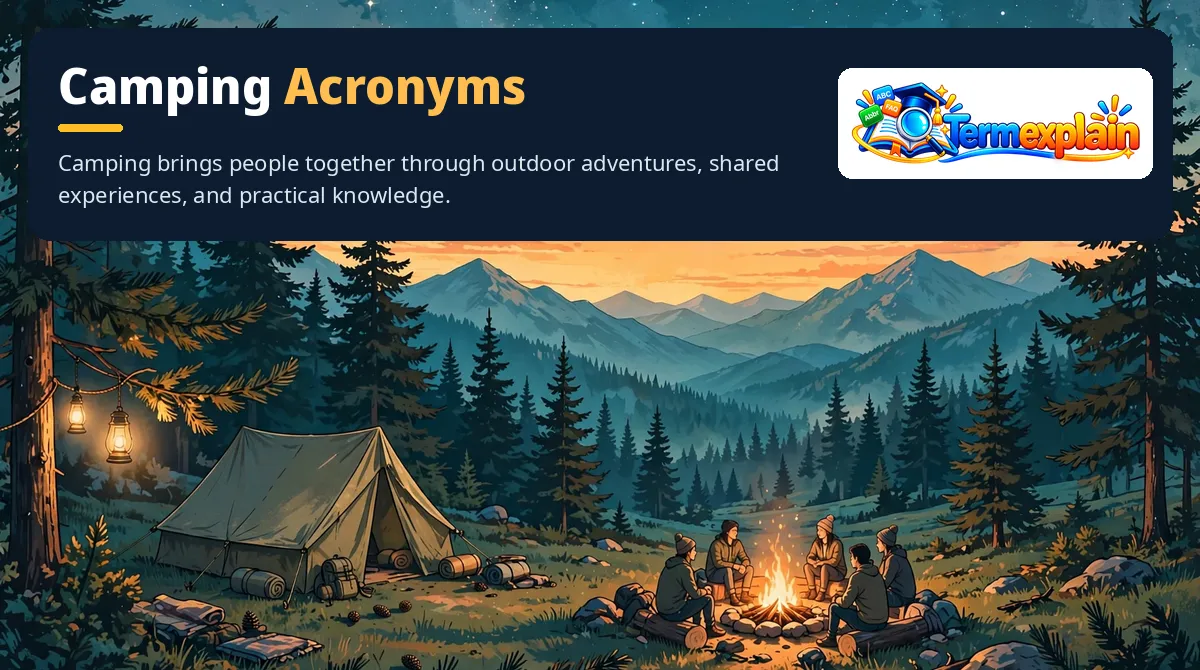
Camping brings people together through outdoor adventures, shared experiences, and practical knowledge.
Whether someone enjoys tent camping, backpacking, RV travel, or wilderness exploration, they will eventually encounter shortened terms used by campers, outdoor guides, park staff, and hiking communities.
Understanding these terms can make conversations easier and help campers follow instructions more confidently.
Acronyms are shortened forms created from the initial letters of multiple words. Some are pronounced as complete words, while others are spoken letter by letter. Abbreviations are a broader category that includes several types of shortened expressions, including acronyms and initialisms.
In the camping world, these terms often relate to equipment, outdoor safety, navigation, campsite facilities, and environmental practices.
For example, a backpacker might discuss their Base Weight (BW), check a GPS device before leaving camp, or follow Leave No Trace (LNT) principles while exploring a natural area.
Learning common camping acronyms is useful for beginners and experienced outdoor enthusiasts alike. This guide explains 25 relevant camping-related terms, their meanings, practical applications, and how to use them correctly in everyday outdoor communication.
Quick Reference Table of 25 Camping Acronyms
The following table provides a quick overview of camping terminology. Some entries are established initialisms or abbreviated expressions rather than technically pronounced-word acronyms. They are included because campers commonly encounter them in outdoor communication.
| Acronym | Full Form | Meaning | Tone | Common Usage Context |
|---|---|---|---|---|
| LNT | Leave No Trace | Minimize environmental impact | Professional | Outdoor ethics |
| GPS | Global Positioning System | Satellite-based positioning | Technical | Navigation |
| RV | Recreational Vehicle | Motorhome or travel vehicle | Neutral | RV camping |
| BW | Base Weight | Backpack weight without consumables | Technical | Backpacking |
| TP | Toilet Paper | Personal hygiene supply | Casual | Camping essentials |
| WFA | Wilderness First Aid | First aid training for remote settings | Professional | Safety |
| WFR | Wilderness First Responder | Advanced wilderness medical training | Professional | Outdoor safety |
| SAR | Search and Rescue | Locating and assisting missing or injured people | Serious | Emergency response |
| FAK | First Aid Kit | Medical supplies for minor injuries | Neutral | Camping preparation |
| BOB | Bug-Out Bag | Emergency evacuation bag | Serious | Emergency preparedness |
| EDC | Everyday Carry | Items carried regularly | Casual | Outdoor preparation |
| UL | Ultralight | Lightweight backpacking approach | Technical | Backpacking |
| AT | Appalachian Trail | Long-distance hiking trail | Neutral | Hiking |
| PCT | Pacific Crest Trail | Long-distance hiking trail | Neutral | Thru-hiking |
| CDT | Continental Divide Trail | Long-distance hiking trail | Neutral | Backpacking |
| BLM | Bureau of Land Management | US public-land management agency | Formal | Public camping areas |
| NPS | National Park Service | US national parks agency | Formal | National parks |
| USFS | United States Forest Service | US forest management agency | Formal | Forest camping |
| OHV | Off-Highway Vehicle | Vehicle designed for off-road travel | Technical | Outdoor recreation |
| AWD | All-Wheel Drive | Power delivered to all wheels | Technical | Vehicle camping |
| 4WD | Four-Wheel Drive | Four-wheel drivetrain system | Technical | Off-road travel |
| REI | Recreational Equipment, Inc. | Outdoor retail cooperative | Neutral | Camping equipment |
| MRE | Meal, Ready-to-Eat | Prepared packaged meal | Neutral | Outdoor food |
| H2O | Water (chemical formula) | Water supply | Informal | Hydration |
| ETA | Estimated Time of Arrival | Expected arrival time | Neutral | Trip planning |
25 Camping Acronyms and Their Meanings
1. LNT – Leave No Trace
Leave No Trace refers to outdoor practices designed to reduce human impact on natural environments. Campers use this expression when discussing responsible camping, hiking, and wilderness activities.
It involves respecting wildlife, disposing of waste properly, staying on appropriate trails, and leaving natural surroundings as undisturbed as possible.
Where It’s Commonly Used: Hiking communities, camping guides, environmental education, and outdoor safety discussions.
Tone: Professional and educational.
Example: “Remember to follow LNT principles and leave the campsite as clean as you found it.”
Similar Terms: Outdoor Ethics, Conservation, Low-Impact Camping.
2. GPS – Global Positioning System
GPS is a satellite-based navigation system that helps determine a person’s location. Campers use GPS-enabled smartphones, watches, and handheld devices to navigate unfamiliar areas and record routes.
It can be especially helpful when exploring large camping grounds or remote hiking locations. However, GPS devices should not replace preparation, physical maps, and backup navigation methods.
Where It’s Commonly Used: Navigation, backpacking, hiking, and outdoor exploration.
Tone: Technical and practical.
Example: “I saved the campsite coordinates on my GPS before leaving home.”
Similar Terms: GNSS, Navigation, Waypoints.
3. RV – Recreational Vehicle
An RV is a vehicle designed or equipped to provide living accommodation while traveling. Depending on its design, it may include sleeping areas, a kitchen, storage, and bathroom facilities.
RV camping allows travelers to carry more equipment and enjoy accommodation without setting up a traditional tent.
Where It’s Commonly Used: Campgrounds, road trips, travel communities, and vehicle camping.
Tone: Neutral and conversational.
Example: “We rented an RV because we wanted a comfortable place to sleep during our road trip.”
Similar Terms: Motorhome, Campervan, Travel Trailer.
4. BW – Base Weight
Base weight is a backpacking measurement describing the weight of a backpack and its equipment before adding consumable supplies such as food, water, and fuel.
It helps hikers understand how heavy their essential equipment will be. Reducing unnecessary items can make longer journeys more comfortable.
Where It’s Commonly Used: Backpacking communities, gear reviews, and ultralight hiking discussions.
Tone: Technical.
Example: “My BW is around 12 pounds, so I still have room for food and water.”
Similar Terms: Pack Weight, Trail Weight, UL.
5. TP – Toilet Paper
TP is a commonly recognized abbreviation for toilet paper. It is an important hygiene supply for many camping trips, particularly when visiting locations without developed restroom facilities.
Campers should follow local disposal rules and pack out used hygiene products when required.
Where It’s Commonly Used: Camping checklists, outdoor preparation, and casual messages.
Tone: Casual.
Example: “Please add TP to the camping shopping list before we leave.”
Similar Terms: Hygiene Supplies, Sanitation Kit.
6. WFA – Wilderness First Aid
Wilderness First Aid refers to first aid education designed for situations where professional medical assistance may be far away.
It helps outdoor participants understand how to respond to injuries and medical problems in remote environments. Training commonly emphasizes assessment, basic care, and planning for evacuation.
Where It’s Commonly Used: Outdoor education, wilderness programs, and camping safety courses.
Tone: Professional.
Example: “Our group leader completed WFA training before organizing the mountain camping trip.”
Similar Terms: WFR, First Aid, Remote Medical Care.
7. WFR – Wilderness First Responder
Wilderness First Responder is a specialized outdoor medical qualification intended for people who may need to provide extended care in remote locations.
It generally involves more extensive training than introductory wilderness first aid. Guides, outdoor educators, and expedition leaders may pursue this qualification.
Where It’s Commonly Used: Wilderness expeditions, outdoor leadership, and professional guiding.
Tone: Professional and serious.
Example: “The expedition hired a guide with WFR training for the remote hiking section.”
Similar Terms: WFA, SAR, Wilderness Medicine.
8. SAR – Search and Rescue
SAR refers to organized efforts to locate and assist people who are missing, injured, or in danger.
Camping and hiking communities encounter this term in emergency plans, park announcements, and wilderness safety discussions.
A SAR operation may involve trained volunteers, emergency personnel, communication equipment, and specialized rescue resources.
Where It’s Commonly Used: Emergency services, national parks, hiking, and wilderness safety.
Tone: Serious and professional.
Example: “The park contacted SAR after the hikers failed to return from their planned route.”
Similar Terms: Emergency Response, Rescue Team, WFR.
9. FAK – First Aid Kit
FAK is an abbreviation used for a first aid kit containing supplies for treating minor injuries and providing basic medical assistance.
A camping first aid kit might contain adhesive bandages, sterile gauze, medical tape, antiseptic supplies, and other items suited to the trip.
The contents should reflect the destination, group size, activities, and potential risks.
Where It’s Commonly Used: Camping checklists, hiking preparation, and emergency planning.
Tone: Practical and neutral.
Example: “Check the FAK before packing because we used several bandages last weekend.”
Similar Terms: First Aid Supplies, WFA, Emergency Kit.
10. BOB – Bug-Out Bag
A Bug-Out Bag is a prepared emergency bag containing essential supplies that someone may need when leaving an unsafe location quickly.
Although it is more closely associated with emergency preparedness than ordinary recreational camping, the term appears in outdoor survival discussions.
Its contents may include water, food, clothing, basic medical supplies, and essential equipment.
Where It’s Commonly Used: Emergency preparedness, survival communities, and outdoor planning.
Tone: Serious.
Example: “We keep a BOB ready with basic supplies in case we need to evacuate.”
Similar Terms: Emergency Bag, Go Bag, EDC.
11. EDC – Everyday Carry
EDC describes the everyday items a person regularly carries for convenience, safety, or practical use. In camping communities, it can refer to useful equipment that someone keeps accessible during outdoor activities.
An outdoor EDC setup might include a flashlight, pocketknife, small multitool, lighter, or compact first aid supplies. The exact selection depends on personal needs and local regulations.
Where It’s Commonly Used: Outdoor preparation, survival discussions, gear communities, and everyday equipment planning.
Tone: Casual and practical.
Example: “My camping EDC includes a flashlight, multitool, and small emergency whistle.”
Similar Terms: BOB, FAK, Outdoor Gear.
12. UL – Ultralight
UL is a shortened form of ultralight, a term used in backpacking to describe an approach focused on reducing equipment weight.
Ultralight hikers carefully select tents, sleeping bags, backpacks, cooking equipment, and clothing to avoid carrying unnecessary weight. However, reducing weight should never come at the expense of essential safety equipment.
Where It’s Commonly Used: Backpacking forums, hiking communities, equipment reviews, and long-distance trail discussions.
Tone: Technical and conversational.
Example: “I’m switching to UL equipment because my current backpack feels too heavy.”
Similar Terms: BW, Lightweight Backpacking, Base Weight.
13. AT – Appalachian Trail
AT is the common initialism for the Appalachian Trail, a long-distance hiking trail in the eastern United States.
It passes through several states and attracts hikers who complete short sections or attempt the entire route. Camping and backpacking discussions frequently use AT as a convenient reference to the trail.
Where It’s Commonly Used: Long-distance hiking, trail planning, backpacking communities, and outdoor travel.
Tone: Neutral and informative.
Example: “We are planning to hike a section of the AT during our summer vacation.”
Similar Terms: PCT, CDT, Thru-Hiking.
14. PCT – Pacific Crest Trail
PCT refers to the Pacific Crest Trail, a long-distance hiking route extending through California, Oregon, and Washington.
It is associated with backpacking, wilderness travel, trail preparation, and extended outdoor adventures. Hikers often use this abbreviation when discussing trail conditions, equipment, and journey planning.
Where It’s Commonly Used: Backpacking, hiking communities, trail journals, and outdoor travel.
Tone: Neutral and informative.
Example: “My friend is preparing for a long-distance backpacking trip on the PCT.”
Similar Terms: AT, CDT, Thru-Hiking.
15. CDT – Continental Divide Trail
CDT is the common abbreviation for the Continental Divide Trail, a long-distance hiking route following the Continental Divide through the United States.
It is an important reference in backpacking discussions, especially among hikers interested in extended wilderness journeys.
Because sections of the trail pass through remote areas, hikers need to plan carefully for navigation, water, weather, and resupply.
Where It’s Commonly Used: Long-distance backpacking, hiking groups, and wilderness trip planning.
Tone: Informative and technical.
Example: “She is researching water sources before beginning her CDT adventure.”
Similar Terms: AT, PCT, Long-Distance Hiking.
16. BLM – Bureau of Land Management
BLM stands for the Bureau of Land Management, a United States federal agency responsible for managing significant areas of public land.
Campers may encounter this term when researching dispersed camping opportunities, recreation rules, road access, and land-use restrictions.
Camping is not automatically permitted everywhere managed by the agency. Visitors should check the rules for the specific location before setting up camp.
Where It’s Commonly Used: Public-land camping, outdoor recreation, travel planning, and government information.
Tone: Formal and informational.
Example: “We checked the BLM website to understand the camping rules for that area.”
Similar Terms: NPS, USFS, Public Lands.
17. NPS – National Park Service
NPS refers to the National Park Service, the United States federal agency responsible for managing national parks and other designated sites.
Campers commonly see this abbreviation when checking campground information, visitor regulations, reservations, park maps, and safety announcements.
The agency’s information can help visitors understand whether a campsite requires reservations or has specific restrictions.
Where It’s Commonly Used: National park camping, tourism, campground reservations, and park regulations.
Tone: Formal and professional.
Example: “I visited the NPS website to check whether the campground accepts reservations.”
Similar Terms: BLM, USFS, National Parks.
18. USFS – United States Forest Service
USFS is the abbreviation for the United States Forest Service, an agency within the US Department of Agriculture.
It manages national forests and grasslands and provides information about recreation, forest conditions, access, and land management.
People planning forest camping trips may encounter USFS information when researching campground availability, fire restrictions, and road closures.
Where It’s Commonly Used: Forest camping, outdoor recreation, public-land management, and trip planning.
Tone: Formal and informative.
Example: “The USFS website lists the current restrictions for the national forest.”
Similar Terms: BLM, NPS, Public Lands.
19. OHV – Off-Highway Vehicle
OHV refers to an off-highway vehicle, a vehicle designed or used for travel away from ordinary public roads.
Examples may include certain all-terrain vehicles, dirt bikes, and other vehicles intended for off-road recreation.
Camping areas sometimes provide designated OHV routes, but riders must follow local access requirements and environmental restrictions.
Where It’s Commonly Used: Off-road camping, outdoor recreation, trail management, and vehicle-based adventures.
Tone: Technical.
Example: “We chose a campground with designated OHV trails for the weekend.”
Similar Terms: ATV, UTV, 4WD.
20. AWD – All-Wheel Drive
AWD describes a vehicle drivetrain system that can deliver power to all four wheels, depending on the vehicle’s design and operating conditions.
It is relevant to car camping because some travelers drive on gravel roads, uneven surfaces, and challenging access routes to reach their destinations.
However, AWD does not guarantee that a vehicle can safely handle every off-road environment.
Where It’s Commonly Used: Car camping, vehicle specifications, outdoor travel, and automotive discussions.
Tone: Technical and practical.
Example: “Our AWD vehicle handled the gravel campground road comfortably.”
Similar Terms: 4WD, OHV, Off-Road Driving.
21. 4WD – Four-Wheel Drive
4WD describes a drivetrain system that can send engine power to all four wheels through a dedicated four-wheel-drive mechanism.
Campers may encounter this term when discussing vehicles used to reach remote campsites or travel across difficult terrain.
Although 4WD can improve traction in appropriate conditions, it does not eliminate the need for careful driving, suitable tires, and route planning.
Where It’s Commonly Used: Off-road camping, vehicle travel, outdoor recreation, and automotive discussions.
Tone: Technical.
Example: “We took the 4WD vehicle because the campsite was beyond a rough dirt road.”
Similar Terms: AWD, OHV, Four-Wheel Drive.
22. REI – Recreational Equipment, Inc.
REI is the name of an American outdoor retail cooperative. It sells equipment and clothing associated with activities such as camping, hiking, cycling, and climbing.
Campers may encounter the name in equipment discussions, product reviews, and outdoor shopping conversations.
Unlike GPS or SAR, REI is a company name rather than a general camping instruction or technical term.
Where It’s Commonly Used: Outdoor retail, camping equipment discussions, gear reviews, and shopping.
Tone: Neutral and conversational.
Example: “I found a lightweight sleeping bag while browsing REI’s camping equipment.”
Similar Terms: Outdoor Retailer, Camping Gear, Outdoor Cooperative.
23. MRE – Meal, Ready-to-Eat
MRE refers to a packaged meal designed to be eaten with little or no additional preparation. The term is particularly associated with military food supplies and emergency preparedness.
Some campers also discuss MREs when planning trips where cooking equipment is limited or convenience is important.
They are not necessarily the best choice for every camping trip because weight, storage, dietary needs, and availability matter.
Where It’s Commonly Used: Emergency supplies, survival preparation, military discussions, and outdoor food planning.
Tone: Practical and neutral.
Example: “We packed an MRE as a backup meal in case cooking became difficult.”
Similar Terms: Dehydrated Meals, Ready-to-Eat Food, Emergency Rations.
24. H2O – Water
H2O is the chemical formula for water. Although it is not technically an acronym or initialism, it is frequently used as a compact written reference to water.
For campers, water is essential for drinking, cooking, cleaning, and maintaining basic hygiene.
Outdoor travelers should plan their water supply according to the route, weather, activity level, and availability of reliable water sources.
Where It’s Commonly Used: Camping checklists, hydration reminders, outdoor education, and informal communication.
Tone: Casual and practical.
Example: “Make sure everyone brings enough H2O for the afternoon hike.”
Similar Terms: Hydration, Drinking Water, Water Supply.
25. ETA – Estimated Time of Arrival
ETA means Estimated Time of Arrival. Campers use it when communicating when they expect to reach a campground, meeting point, trailhead, or outdoor destination.
It is particularly useful when a group is traveling in separate vehicles or when someone is coordinating campsite arrangements.
Sharing an ETA also helps other group members plan meals, prepare equipment, and avoid unnecessary waiting.
Where It’s Commonly Used: Group messages, road trips, campsite coordination, and outdoor travel planning.
Tone: Neutral and practical.
Example: “Our ETA at the campsite is around 4:30 PM, so please start preparing dinner.”
Similar Terms: Arrival Time, GPS, Trip Schedule.
Acronyms vs Abbreviations vs Initialisms
Camping conversations include several types of shortened expressions. Although people often call all of them acronyms, there are small differences worth understanding.
| Type | Meaning | Example |
|---|---|---|
| Abbreviation | A general shortened form of a word or phrase | TP |
| Acronym | A shortened form made from initial letters and generally pronounced as a word | NASA |
| Initialism | A shortened form pronounced one letter at a time | GPS, RV, SAR |
Abbreviations: An abbreviation is a broad term covering shortened words and expressions. For example, TP is a shortened written form of toilet paper.
Acronyms: An acronym combines initial letters or parts of words and is generally pronounced as a complete word. NASA is a familiar example.
Initialisms: Initialisms are formed from initial letters but are spoken individually. GPS is pronounced by saying the letters G, P, and S.
The distinction is important when discussing language accurately. For instance, GPS, RV, and ETA are technically initialisms rather than conventional word-pronounced acronyms.
Everyday communication is sometimes less strict. People regularly use the word acronym to describe almost any shortened expression.
Similarly, H2O is a chemical formula, while REI is a company name. Neither should be treated as a conventional camping acronym simply because it appears in a list of outdoor terminology.
Common Mistakes with Camping Acronyms
Camping terminology can make outdoor communication quicker, but using shortened expressions incorrectly can create confusion. Here are some mistakes worth avoiding.
1. Using Unfamiliar Acronyms in Conversations
Not everyone understands outdoor terminology. A beginner might not know what BW, UL, or WFR means.
Instead of assuming everyone understands these expressions, explain unfamiliar terms when communicating with new campers.
2. Confusing Similar Camping Terms
Some outdoor expressions have related meanings but are not interchangeable.
For example, AWD and 4WD describe different drivetrain systems. Similarly, WFA and WFR refer to different levels of wilderness medical training.
Understanding these differences helps prevent misunderstandings.
3. Using Technical Terms in the Wrong Context
Some abbreviations belong to particular industries or organizations.
For example, BLM refers to the Bureau of Land Management in the context of US public lands. It should not automatically be interpreted that way in unrelated conversations.
Always consider the surrounding subject before deciding what an abbreviation means.
4. Overusing Acronyms in Written Communication
Using too many shortened expressions can make a camping checklist or travel message difficult to understand.
For example, writing “Check GPS, FAK, BOB, EDC, and BW before AT” may confuse someone unfamiliar with outdoor terminology.
A clearer sentence explains the important equipment and destination.
5. Forgetting to Introduce Unfamiliar Terms
When writing a camping guide, introduce an unfamiliar term using its full name before using its shortened form.
For example:
“Wilderness First Aid (WFA) prepares participants to respond to medical situations in remote environments.”
After introducing it, you can use WFA throughout the remaining discussion.
6. Assuming Every Shortened Form Is an Acronym
This is a common terminology mistake. GPS and RV are initialisms because people pronounce their letters individually. H2O is a chemical formula, not an acronym.
Recognizing these differences makes your writing more accurate without making ordinary conversations unnecessarily complicated.
How to Use Camping Acronyms Correctly
Knowing the meanings of camping abbreviations is only part of effective communication. You should also understand when to use them, who your audience is, and whether a shortened expression makes your message clearer.
Using Camping Acronyms in Professional Emails
When communicating with campground managers, outdoor guides, travel companies, or park officials, clarity should come first.
Use familiar terms where appropriate, but explain less common expressions when introducing them.
For example:
“We plan to arrive at the campground by 3 PM. Our estimated time of arrival (ETA) may change depending on road conditions.”
This approach makes the message understandable without unnecessary explanations.
Using Camping Acronyms in Academic Writing
Students writing about outdoor recreation, environmental conservation, or wilderness safety should introduce technical terminology properly.
For example:
“Leave No Trace (LNT) principles encourage visitors to minimize their environmental impact.”
Once the complete expression has been introduced, LNT can be used throughout the remaining text.
Academic writing should also distinguish between acronyms, initialisms, abbreviations, and chemical formulas when the distinction is relevant.
Using Camping Acronyms in Text Messages
Informal messaging is one of the easiest places to use familiar shortened expressions.
For example:
- “What’s our ETA at the campsite?”
- “Don’t forget the TP.”
- “I saved the route on my GPS.”
- “Please check the FAK before we leave.”
These messages are short and practical because the people involved are likely to understand the terminology.
However, avoid unfamiliar abbreviations when messaging people who are new to camping.
Using Camping Acronyms in International Communication
Camping terminology can vary between countries, organizations, and outdoor communities.
For example, BLM, NPS, and USFS refer to specific American government agencies. Someone camping in another country may not recognize these terms.
When communicating internationally, use the complete name of an organization or explain the abbreviation.
Similarly, avoid assuming that every camper uses the same equipment terminology or follows identical outdoor regulations.
Choosing Acronyms According to Your Audience
Consider three things before using a shortened expression:
- Familiarity: Does the other person already understand the term?
- Formality: Is the conversation professional, academic, or casual?
- Context: Does the abbreviation belong to the subject being discussed?
A familiar expression such as GPS usually requires little explanation. However, specialized terms such as WFR may need additional context.
The best approach is to use shortened expressions when they improve communication, not simply to make sentences shorter.
Practice Section: Test Your Camping Acronym Knowledge
Practice helps you remember camping terminology and recognize how these expressions appear in everyday outdoor conversations.
Fill in the Blanks
Complete each sentence using the correct camping-related abbreviation.
- We use a __________ device to identify our location while hiking through unfamiliar terrain.
- Always follow __________ principles to protect natural camping environments.
- My __________ includes a flashlight, multitool, and emergency whistle.
- The hikers contacted __________ after someone went missing on the trail.
- We rented an __________ because we wanted comfortable accommodation during our road trip.
- The group leader completed __________ training before organizing the remote expedition.
- My backpack’s __________ is 11 pounds without food, water, and fuel.
- We checked the __________ website for information about national park reservations.
- Please pack enough __________ for the entire camping weekend.
- Our __________ at the campsite is approximately 5 PM.
Multiple-Choice Questions
1. What does LNT mean in camping?
A. Leave No Trace
B. Long Night Travel
C. Local Nature Trail
D. Lightweight Navigation Tool
2. Which abbreviation refers to the Pacific Crest Trail?
A. AT
B. CDT
C. PCT
D. GPS
3. What does FAK commonly represent?
A. Forest Access Kit
B. First Aid Kit
C. Food And Kitchen
D. Field Adventure Knowledge
4. Which term describes an ultralight backpacking approach?
A. UL
B. RV
C. SAR
D. NPS
5. What does MRE mean?
A. Mountain Recreation Equipment
B. Meal, Ready-to-Eat
C. Medical Rescue Essentials
D. Mobile Recreation Environment
Rewrite the Full Sentence Using the Acronym
Replace the bold expression with its appropriate shortened form.
- We should follow Leave No Trace principles during our camping trip.
- The guide used the Global Positioning System to navigate the forest.
- Our Recreational Vehicle has enough sleeping space for the entire family.
- The rescue team started a Search and Rescue operation in the mountains.
- We checked the Estimated Time of Arrival before preparing dinner.
Complete Answer Key
Fill in the Blanks
- GPS
- LNT
- EDC
- SAR
- RV
- WFA
- BW
- NPS
- TP
- ETA
Multiple-Choice Questions
| Question | Correct Answer |
|---|---|
| 1 | A. Leave No Trace |
| 2 | C. PCT |
| 3 | B. First Aid Kit |
| 4 | A. UL |
| 5 | B. Meal, Ready-to-Eat |
Rewrite the Full Sentence
- We should follow LNT principles during our camping trip.
- The guide used the GPS to navigate the forest.
- Our RV has enough sleeping space for the entire family.
- The rescue team started a SAR operation in the mountains.
- We checked the ETA before preparing dinner.
Frequently Asked Questions
1. What Are the Most Common Camping Acronyms?
Some commonly encountered camping-related abbreviations include GPS (Global Positioning System), RV (Recreational Vehicle), LNT (Leave No Trace), SAR (Search and Rescue), and FAK (First Aid Kit). They help people communicate about navigation, accommodation, environmental responsibility, and outdoor safety.
2. What Does LNT Mean in Camping?
LNT means Leave No Trace. It refers to outdoor practices that help protect natural environments by reducing the impact of camping, hiking, and other recreational activities.
3. What Does BW Mean in Backpacking?
BW generally means Base Weight. It describes the weight of a backpack and its equipment without consumable supplies such as food, water, and fuel. Backpackers use this measurement to evaluate and manage their equipment weight.
4. What Does UL Mean in Camping?
UL means Ultralight. It describes a backpacking approach that focuses on carrying lightweight equipment while maintaining the supplies needed for a safe and comfortable outdoor experience.
5. Are Camping Acronyms and Camping Abbreviations the Same?
Not technically. Acronyms are generally pronounced as complete words, while initialisms are spoken letter by letter. Abbreviations are the broader category of shortened expressions. Although campers often use these terms interchangeably in everyday conversation, their linguistic meanings are different.
Conclusion
Camping acronyms make outdoor communication more convenient, especially when discussing equipment, navigation, safety, public lands, and backpacking.
Understanding expressions such as LNT, GPS, BW, FAK, and SAR can help beginners follow camping discussions and communicate more confidently with experienced outdoor enthusiasts.
However, knowing an abbreviation’s full form is not enough. Its context and intended meaning matter just as much. Some terms describe technical equipment, others refer to government agencies, and several are simply convenient expressions used in everyday outdoor conversations.
The best approach is to learn the terminology gradually, introduce unfamiliar expressions when necessary, and choose words that your audience understands.
Clear communication makes camping preparation easier and helps everyone enjoy a safer, more organized outdoor experience.

Alden Rowen is a contributing author at Word Explain, specializing in abbreviations and acronyms. He creates clear, concise, and easy-to-understand explanations to help readers discover the meanings of commonly used terms and keywords.