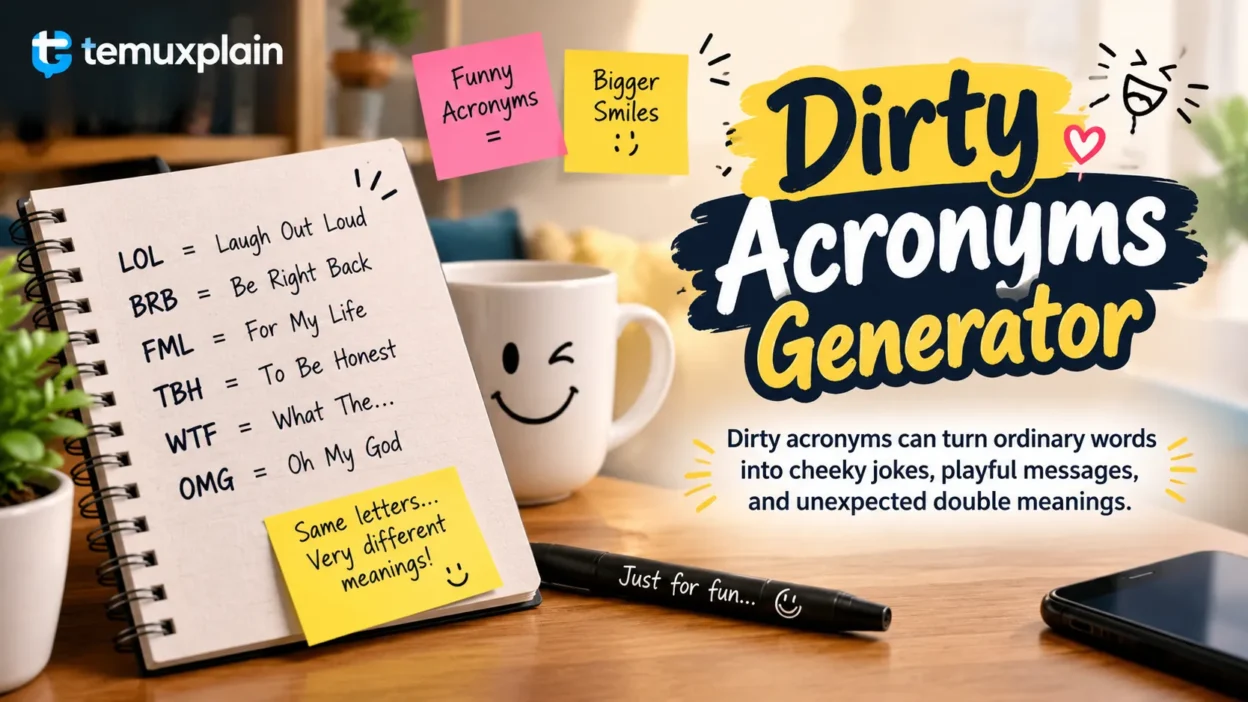
Dirty acronyms can turn ordinary words into cheeky jokes, playful messages, and unexpected double meanings.
A dirty acronym generator is a creative tool or idea format that uses the letters of a word or phrase to build a humorous, suggestive, or mildly naughty expression.
The fun comes from giving familiar letters a completely different meaning, often in a way that surprises the reader.
An acronym is generally pronounced as a word, while an initialism is spoken letter by letter. Both are often called acronyms in casual conversation, even when the technical distinction matters. In playful word games, the focus is usually less on linguistic terminology and more on creativity, timing, and humor.
People use dirty acronym ideas in private chats, funny captions, friendly banter, adult humor, party games, and fictional dialogue.
The right choice depends on the audience: a cheeky joke between consenting adults may be inappropriate in a workplace message or an unfamiliar group chat.
In this guide, you will find 22 original, cheeky acronym ideas, explanations of how they work, practical tips for creating your own, and examples of when to use them. You will also learn how to keep the humor funny rather than confusing, offensive, or out of place.
Quick Reference Table
| Acronym | Playful Full Form | Meaning | Tone | Common Usage Context |
|---|---|---|---|---|
| FLIRT | Flirty Lines, Interesting Replies, Teasing | Playful romantic conversation | Cheeky | Dating chats |
| KISS | Keep It Sweet, Seriously | Affectionate or teasing advice | Cute | Texting |
| SPICY | Suggestive Play, Imagination, Cheeky Yearnings Included | Suggestive humor | Flirty | Private chats |
| NAUGHTY | Naturally Audacious, Unusually Good Humor Teasing You | Mischievous behavior | Playful | Jokes |
| WINK | Words Implying Naughty Knowledge | A hint of double meaning | Cheeky | Captions |
| TEASE | Tempting Expressions And Suggestive Exchanges | Playful flirtation | Flirty | Dating |
| CRUSH | Cute Replies Usually Spark Heat | Romantic interest | Sweet | Texting |
| HOT | Humor, Openness, Teasing | Confident, playful banter | Cheeky | Social chats |
| XO | Hugs and Kisses | Affection or a warm sign-off | Affectionate | Messages |
| LUST | Lighthearted Unspoken Suggestive Tension | Suggestive attraction | Adult humor | Fiction and jokes |
| SASS | Smart Attitude, Suggestive Style | Bold, witty humor | Sassy | Captions |
| CHEEKY | Charming Humor, Expressing Entertaining Kinks, You know | Mischievous humor | Playful | Banter |
| DATE | Daring Adventures, Teasing Exchanges | Flirty time together | Romantic | Dating |
| BOO | Beloved One, Obviously | A playful term of affection | Cute | Texting |
| SMILE | Suggestive Messages Inspire Laughs Easily | Humor with a hint of flirtation | Lighthearted | Private chats |
| VIBE | Verbal Invitations, Bold Energy | A playful social atmosphere | Casual | Social chats |
| MOOD | Mischief Often Overrules Decorum | A cheeky state of mind | Naughty | Captions |
| WILD | Witty Ideas, Little Decorum | Unrestrained humor | Mischievous | Party games |
| POUT | Playfully Offering Unspoken Teasing | A teasing expression | Flirty | Messages |
| DARE | Daring Antics, Risqué Energy | A cheeky challenge | Bold | Party games |
| BLUSH | Bold Lines Usually Spark Heat | A reaction to flirtation | Romantic | Dating chats |
| SAUCY | Suggestive Attitude, Unexpectedly Clever Humor | Bold or slightly naughty humor | Cheeky | Captions |
These are creative, original expansions for entertainment, not established dictionary meanings or standardized acronyms. Some are deliber
22 Dirty Acronyms and Their Funny Meanings
The following ideas use playful word combinations, flirtatious hints, and mild adult humor. They are intentionally creative rather than official definitions, so you can adapt them for jokes, captions, and private conversations.
1. FLIRT — Flirty Lines, Interesting Replies, Teasing
FLIRT works well as a playful acronym because the word itself already describes a style of romantic interaction. This expansion emphasizes the back-and-forth that makes flirting entertaining: clever comments, quick responses, and a little teasing.
Where it’s commonly used: Dating apps, private messages, romantic comedy dialogue.
Tone: Flirty and playful.
Example: “Your FLIRT game is strong, but your jokes need work.”
Similar ideas: CRUSH, TEASE, WINK.
2. KISS — Keep It Sweet, Seriously
KISS gives a familiar romantic word a humorous twist. In this version, it is advice to keep a conversation affectionate and simple instead of turning every exchange into an elaborate attempt to impress someone.
Where it’s commonly used: Text messages, romantic notes, playful captions.
Tone: Cute, affectionate, slightly cheeky.
Example: “My advice for your first date? KISS: Keep It Sweet, Seriously.”
Similar ideas: XO, BOO, FLIRT.
3. SPICY — Suggestive Play, Imagination, Cheeky Yearnings Included
SPICY suits jokes that are a little more suggestive than ordinary romantic banter. Its playful expansion hints at adult humor without requiring graphic language.
Where it’s commonly used: Private chats between consenting adults, humorous captions, fictional dialogue.
Tone: Suggestive and mischievous.
Example: “That conversation went from ordinary to SPICY in about five minutes.”
Similar ideas: SAUCY, LUST, WINK.
4. NAUGHTY — Naturally Audacious, Unusually Good Humor Teasing You
NAUGHTY describes someone who enjoys pushing the boundaries of innocent humor. This invented expansion emphasizes mischievous jokes and confident teasing rather than genuinely harmful behavior.
Where it’s commonly used: Adult party games, friendly banter, comedy captions.
Tone: Mischievous and humorous.
Example: “Your NAUGHTY sense of humor always catches me off guard.”
Similar ideas: WILD, SAUCY, SASS.
5. WINK — Words Implying Naughty Knowledge
A wink can suggest that a message has a second meaning. This expansion captures the feeling of a joke that sounds innocent on the surface but carries a cheeky implication for someone who understands the context.
Where it’s commonly used: Flirty messages, humorous captions, playful conversations.
Tone: Subtle and suggestive.
Example: “That innocent-looking message definitely came with a WINK.”
Similar ideas: FLIRT, SPICY, TEASE.
6. TEASE — Tempting Expressions And Suggestive Exchanges
TEASE is suitable for playful exchanges where two people trade witty comments without taking themselves too seriously. The humor depends on mutual understanding and the right timing.
Where it’s commonly used: Dating conversations, romantic comedy, playful text exchanges.
Tone: Flirty and mischievous.
Example: “Stop trying to TEASE me with those mysterious messages.”
Similar ideas: FLIRT, WINK, CRUSH.
7. CRUSH — Cute Replies Usually Spark Heat
CRUSH focuses on the excitement of liking someone and hoping they return the interest. The invented phrase suggests that a thoughtful or funny reply can make an ordinary conversation feel more exciting.
Where it’s commonly used: Dating chats, relationship jokes, social captions.
Tone: Romantic and playful.
Example: “One clever reply from my CRUSH, and suddenly I’m smiling at my phone.”
Similar ideas: FLIRT, DATE, BLUSH.
8. HOT — Humor, Openness, Teasing
HOT gives a familiar word an interpretation centered on confidence and playful conversation. It works best as a joke about chemistry rather than a literal description of someone’s appearance.
Where it’s commonly used: Private chats, dating humor, playful social posts.
Tone: Confident and cheeky.
Example: “The conversation was HOT because the jokes were actually good.”
Similar ideas: SPICY, LUST, SAUCY.
9. XO — Hugs and Kisses
XO is a conventional written symbol of affection, commonly used as a friendly or romantic sign-off. It is not a strict acronym formed from the initial letters of “Hugs and Kisses,” but it belongs naturally in a guide to playful romantic shorthand.
Where it’s commonly used: Text messages, personal notes, cards, affectionate sign-offs.
Tone: Warm and affectionate.
Example: “Had a lovely time tonight. Talk tomorrow, XO.”
Similar ideas: KISS, BOO, CRUSH.
10. LUST — Lighthearted Unspoken Suggestive Tension
LUST is more adult-oriented than a simple crush. This playful expansion describes a situation where attraction is suggested through dialogue, expressions, or the atmosphere rather than stated directly.
Where it’s commonly used: Adult humor, romantic fiction, private conversations.
Tone: Suggestive and mature.
Example: “The scene relied on LUST and clever dialogue instead of an obvious confession.”
Similar ideas: HOT, SPICY, FLIRT.
11. SASS — Smart Attitude, Suggestive Style
SASS emphasizes confidence, sharp replies, and humor with a little attitude. It does not have to be sexual; the suggestive element comes from the particular joke or situation.
Where it’s commonly used: Funny captions, group chats, comedy dialogue.
Tone: Witty, bold, and playful.
Example: “She answered with so much SASS that nobody knew whether to laugh or apologize.”
Similar ideas: WILD, NAUGHTY, SAUCY.
12. CHEEKY — Charming Humor, Expressing Entertaining Kinks, You Know
CHEEKY is a deliberately unconventional expansion built around mischievous humor. The reference to kinks makes this version more suitable for adult audiences than for general family-friendly jokes.
Where it’s commonly used: Private adult conversations, themed party games, fictional comedy.
Tone: Suggestive and mischievous.
Example: “That was a CHEEKY answer for such an innocent question.”
Similar ideas: NAUGHTY, SPICY, LUST.
13. DATE — Daring Adventures, Teasing Exchanges
DATE frames a romantic outing as an opportunity for enjoyable conversation and playful discovery. The expansion is especially useful for jokes about first dates, awkward silences, and unexpected chemistry.
Where it’s commonly used: Dating apps, romantic messages, relationship humor.
Tone: Romantic and lighthearted.
Example: “Our DATE included terrible dancing, excellent food, and nonstop teasing.”
Similar ideas: CRUSH, FLIRT, BLUSH.
14. BOO — Beloved One, Obviously
BOO is a familiar affectionate nickname in some English-speaking communities. This invented expansion turns it into a simple joke about someone being a favorite person.
Where it’s commonly used: Romantic texts, affectionate captions, relationship banter.
Tone: Cute and casual.
Example: “Movie night with my BOO beats another night scrolling alone.”
Similar ideas: XO, KISS, CRUSH.
15. SMILE — Suggestive Messages Inspire Laughs Easily
SMILE suits a conversation where humor and flirting happen together. The point is that a well-timed message can make someone laugh without being explicit or overly forward.
Where it’s commonly used: Private messages, dating conversations, lighthearted captions.
Tone: Sweet and cheeky.
Example: “Your SMILE strategy is working; I keep laughing at my phone.”
Similar ideas: FLIRT, WINK, TEASE.
16. VIBE — Verbal Invitations, Bold Energy
VIBE describes the atmosphere between people when their conversation feels natural and engaging. This expansion connects that feeling to confident remarks and playful invitations.
Where it’s commonly used: Social media captions, dating chats, party conversations.
Tone: Casual and confident.
Example: “The VIBE was right, the music was good, and nobody wanted to leave.”
Similar ideas: HOT, DATE, FLIRT.
17. MOOD — Mischief Often Overrules Decorum
MOOD works as a funny description of a moment when someone feels unusually playful. Here, “decorum” refers to the expectation that people behave in a more restrained or proper way.
Where it’s commonly used: Memes, humorous captions, private chats.
Tone: Mischievous and humorous.
Example: “Sending that ridiculous joke at midnight was a MOOD.”
Similar ideas: SASS, WILD, NAUGHTY.
18. WILD — Witty Ideas, Little Decorum
WILD fits humor that is bold, unpredictable, or a little inappropriate for a formal setting. It can refer to a ridiculous joke just as easily as a suggestive one.
Where it’s commonly used: Adult party games, comedy captions, informal group chats.
Tone: Bold and mischievous.
Example: “That WILD comment completely changed the direction of the conversation.”
Similar ideas: MOOD, SASS, NAUGHTY.
19. POUT — Playfully Offering Unspoken Teasing
POUT describes a playful expression that communicates mock disappointment or an attempt to get attention. The acronym gives that familiar gesture a flirtatious interpretation.
Where it’s commonly used: Romantic banter, humorous messages, fictional dialogue.
Tone: Cute and teasing.
Example: “He gave a dramatic POUT when everyone chose a different movie.”
Similar ideas: TEASE, FLIRT, BLUSH.
20. DARE — Daring Antics, Risqué Energy
DARE is a natural fit for playful challenges. This version suggests a bold or slightly suggestive activity, although the challenge itself can be entirely harmless.
Where it’s commonly used: Adult party games, friendly challenges, comedy dialogue.
Tone: Bold and playful.
Example: “Your DARE is to deliver that terrible pickup line without laughing.”
Similar ideas: WILD, SPICY, NAUGHTY.
21. BLUSH — Bold Lines Usually Spark Heat
BLUSH connects flirtatious humor with the familiar reaction of becoming embarrassed or bashful. Its expansion works for jokes about compliments, unexpected messages, and awkward romantic moments.
Where it’s commonly used: Dating chats, relationship captions, romantic comedy.
Tone: Sweet and flirtatious.
Example: “That compliment made me BLUSH before I could think of a reply.”
Similar ideas: CRUSH, FLIRT, KISS.
22. SAUCY — Suggestive Attitude, Unexpectedly Clever Humor
SAUCY describes a cheeky style of humor that is confident, witty, and sometimes suggestive. The best examples rely on clever wording rather than simply making a joke more explicit.
Where it’s commonly used: Adult humor, playful captions, private messages.
Tone: Cheeky and witty.
Example: “That was a SAUCY comeback, and the timing made it even funnier.”
Similar ideas: SPICY, SASS, CHEEKY.
Acronyms vs. Abbreviations vs. Initialisms
Understanding the difference helps you create better wordplay and describe your ideas accurately.
| Type | Explanation | Example |
|---|---|---|
| Abbreviation | A broad category of shortened forms | Dr. for Doctor |
| Acronym | Initial letters or parts of words pronounced as a word | NASA |
| Initialism | Initial letters pronounced separately | LOL |
A dirty acronym generator usually takes a word and assigns a new phrase to its letters. For instance, FLIRT can be expanded into “Flirty Lines, Interesting Replies, Teasing.” The result is a creative backronym: an existing word is used as the starting point, and a phrase is invented to fit it.
Not every expansion will be a technically strict acronym. XO, for example, is conventional shorthand for affection rather than a standard initial-letter construction. This distinction matters in linguistic explanations, although casual word games are often flexible about terminology.
Common Mistakes When Creating Dirty Acronyms
Forcing Words to Fit the Letters
An expansion becomes difficult to understand when the words do not form a coherent phrase. Choose wording that communicates a recognizable idea instead of adding random words just to fill every letter.
Making Every Joke Explicit
Suggestive humor often works because it leaves room for interpretation. A clever double meaning can be funnier than an overly direct expression.
Ignoring the Audience
A private joke between consenting adults may be welcome in one conversation and inappropriate in another. Avoid sending sexual jokes to people who have not welcomed that kind of interaction.
Confusing Creativity With Established Meaning
An invented expansion is not automatically a recognized definition. Label your creations as humorous interpretations instead of claiming that everyone uses the same full form.
Repeating the Same Type of Joke
If every acronym describes attraction, the list quickly becomes predictable. Mix romantic humor, wordplay, cheeky challenges, and silly situations to keep the ideas fresh.
Using Suggestive Acronyms in Formal Communication
A playful expansion might suit a private joke, but it rarely belongs in a professional email, academic assignment, or formal presentation. Choose language appropriate to the setting.
How to Use a Dirty Acronyms Generator
In Private Messages
Use short, easy-to-understand expansions that fit the conversation. A word such as WINK or FLIRT can introduce playful teasing without making the message overly complicated.
For example: “That reply deserves a WINK.”
The goal is to create a shared joke, not to make the recipient guess what the message means.
In Social Media Captions
Choose a word that matches the photo or situation. SASS works for a witty caption, while BLUSH may suit a lighthearted post about receiving a compliment.
Keep the wording readable. An acronym that needs several sentences of explanation may not work well as a short caption.
In Adult Party Games
Words such as DARE, SPICY, and WILD can be used as prompts for making humorous expansions. Agree on the tone and boundaries before playing, particularly when the group includes people with different comfort levels.
Participants should always be free to skip a question or challenge.
In Creative Writing
Invented acronyms can help establish a character’s personality. A witty character might use SASS as a running joke, while a romantic character might invent a playful meaning for CRUSH.
Use the acronym naturally within dialogue instead of explaining every joke immediately.
In Professional or Academic Writing
Avoid suggestive expansions unless the subject specifically calls for an analysis of adult humor, language, or wordplay. If an acronym is relevant to a serious discussion, explain what it means and distinguish an invented expansion from an established linguistic term.
When Sharing Across Cultures
Slang, sexual humor, and affectionate expressions do not translate consistently across languages and communities. A phrase that sounds playful to one person may seem rude or confusing to another.
If the audience is unfamiliar with the joke, explain it briefly or choose a more universal form of humor.
Practice: Test Your Acronym Skills
The following exercises use the creative expansions and linguistic concepts explained above.
Fill in the Blanks
Complete each sentence with the appropriate acronym or term.
- ______ is a playful expansion associated with flirty lines and teasing replies.
- ______ is a conventional shorthand expression for affection, commonly written at the end of a message.
- The expansion “Mischief Often Overrules Decorum” uses the word ______.
- ______ describes witty, suggestive humor with a bold attitude.
- The word ______ can represent a playful romantic challenge.
- ______ is associated with a bashful reaction to a compliment.
- An acronym generally pronounced as a word differs from an ______, which is pronounced letter by letter.
- The broad category that includes shortened words and phrases is called an ______.
- ______ is a playful word associated with a bold or mischievous style.
- A phrase invented to fit an existing word’s letters is commonly called a ______.
Multiple-Choice Questions
1. Which word is associated with “Words Implying Naughty Knowledge”?
A. WINK
B. BOO
C. DATE
D. MOOD
2. Which option is a conventional expression of affection rather than a strict acronym?
A. FLIRT
B. XO
C. SASS
D. DARE
3. What makes a creative acronym expansion effective?
A. It must always sound explicit.
B. It should use random words.
C. It should make sense and suit the intended audience.
D. It should be difficult to understand.
4. Which term describes an existing word given a newly invented expansion?
A. Backronym
B. Punctuation
C. Translation
D. Contraction
5. Where should suggestive jokes generally be avoided unless clearly appropriate?
A. A private adult comedy game
B. A mutually welcomed playful conversation
C. A formal professional email
D. Fiction written for an adult audience
Rewrite the Full Sentence Using the Acronym
Replace the relevant phrase with the matching creative acronym from this article.
- “Her flirty lines, interesting replies, and teasing made the conversation entertaining.”
- “His mischievous attitude was a perfect example of witty ideas with little decorum.”
- “The compliment made me feel bashful and embarrassed.”
- “We planned a playful challenge with daring antics and risqué energy.”
- “She ended the affectionate message with the familiar symbol for hugs and kisses.”
Answer Key
Fill in the blanks
- FLIRT
- XO
- MOOD
- SAUCY
- DARE
- BLUSH
- Initialism
- Abbreviation
- WILD
- Backronym
Multiple choice
- A — WINK
- B — XO
- C — It should make sense and suit the intended audience.
- A — Backronym
- C — A formal professional email
Rewrite the sentences
- “Her FLIRT style made the conversation entertaining.”
- “His MOOD was a perfect example of WILD humor.”
- “That compliment made me BLUSH.”
- “We planned a DARE with a little risqué energy.”
- “She ended the affectionate message with XO.”
The rewrite answers are illustrative; the goal is to use the relevant term naturally while preserving the original meaning.
Frequently Asked Questions
What is a dirty acronyms generator?
A dirty acronyms generator is a creative tool or word game that assigns humorous, suggestive, or mildly naughty phrases to the letters of a word. The expansions are often invented for entertainment rather than taken from established terminology.
How do you make a funny dirty acronym?
Start with a recognizable word, decide on the joke or meaning you want to communicate, and create a phrase that fits its letters. Keep the wording natural and make sure the humor suits your audience.
Are dirty acronym meanings official?
Usually not. In this context, most expansions are creative interpretations, not standardized definitions. If you share one, make it clear that it is a joke or an invented meaning.
Can I use dirty acronyms in text messages?
Yes, when the conversation and audience make that kind of humor appropriate. Private chats between consenting adults may allow more suggestive jokes, while professional or unfamiliar settings generally call for more restraint.
What is the difference between a dirty acronym and a backronym?
A dirty acronym is a broad description of a suggestive or naughty acronym-style joke. A backronym is a word that is given a newly invented phrase to match its existing letters. A dirty acronym can therefore also be a backronym.
Conclusion
Dirty acronym wordplay combines familiar words with unexpected meanings to create jokes, flirtatious messages, and cheeky captions.
The most effective ideas are easy to understand, suit the situation, and use clever wording rather than relying entirely on explicit humor.
Treat invented expansions as creative interpretations, not official definitions.
Whether you are making a party-game prompt, writing a funny caption, or sharing a private joke, a little originality and awareness of your audience can make the difference between a clever line and an awkward one.

Alden Rowen is a contributing author at Word Explain, specializing in abbreviations and acronyms. He creates clear, concise, and easy-to-understand explanations to help readers discover the meanings of commonly used terms and keywords.