
Fire alarm systems rely on specialized terminology to help technicians, electricians, engineers, building managers, and emergency responders communicate clearly.
From control panels and detection devices to notification circuits and monitoring equipment, shortened terms appear throughout fire safety documents, installation drawings, inspection reports, and maintenance procedures.
Understanding these terms is important because fire alarm terminology is not limited to simple abbreviations. Some shortened forms are acronyms pronounced as words, while others are initialisms spoken letter by letter. Both are commonly encountered in the fire protection industry.
For example, FACP identifies the main control panel responsible for processing fire alarm signals, while NAC refers to the circuit used to connect notification appliances such as horns and strobes.
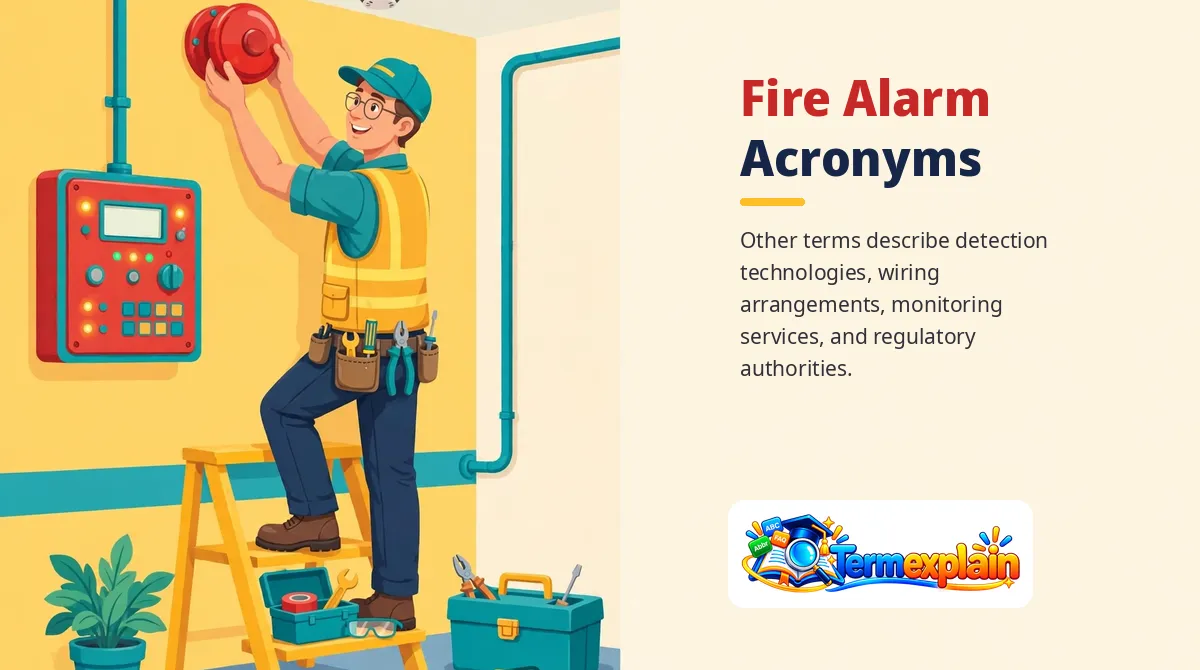
Other terms describe detection technologies, wiring arrangements, monitoring services, and regulatory authorities.
In this guide, you will discover 29 fire alarm acronyms and commonly used initialisms, their full forms, straightforward explanations, practical applications, and realistic examples.
You will also learn how to distinguish similar terms and use fire safety terminology correctly in professional communication.
Quick Reference Table: 29 Fire Alarm Acronyms
The following terms cover fire alarm control equipment, detection devices, electrical components, safety standards, monitoring services, and building protection systems. Some are technically initialisms or standard abbreviations rather than acronyms.
| Acronym | Full Form | Meaning | Tone | Common Usage Context |
|---|---|---|---|---|
| AHJ | Authority Having Jurisdiction | Organization or official responsible for enforcing applicable safety requirements | Formal | Inspections |
| AHU | Air Handling Unit | Equipment that circulates and conditions building air | Technical | HVAC interfaces |
| AIM | Addressable Input Module | Module that monitors external input signals | Technical | Addressable systems |
| ANSI | American National Standards Institute | Organization that coordinates voluntary standards | Formal | Standards |
| ASSD | Air Sampling Smoke Detector | Detector that analyzes air samples for smoke | Technical | Fire detection |
| ASD | Aspirating Smoke Detection | Technology that samples air to identify smoke particles | Technical | Early detection |
| ARC | Alarm Receiving Centre | Facility that receives alarm signals remotely | Professional | Monitoring |
| AWG | American Wire Gauge | Standard used to identify electrical wire sizes | Technical | Wiring |
| C&E | Cause and Effect | Document describing system responses to specific events | Professional | System design |
| CIE | Control and Indicating Equipment | Equipment that controls and displays fire alarm conditions | Technical | Fire alarm systems |
| MCP | Manual Call Point | Device used to manually raise a fire alarm | Formal | Emergency activation |
| PSU | Power Supply Unit | Equipment that provides electrical power to a system | Technical | Installation |
| VAD | Visual Alarm Device | Equipment that provides a visible warning, such as a flashing light | Technical | Occupant notification |
| PIV | Post Indicator Valve | Device that indicates the position of a fire protection water valve | Technical | Sprinkler systems |
| OS&Y | Outside Stem and Yoke | Valve design that provides a visible indication of valve position | Technical | Fire protection |
| UL | Underwriters Laboratories | Safety testing and certification organization | Formal | Product certification |
| NFPA | National Fire Protection Association | Organization that develops fire and life safety codes and standards | Formal | Fire safety |
| NEC | National Electrical Code | Electrical installation code published as NFPA 70 | Formal | Electrical work |
| ADA | Americans with Disabilities Act | US law addressing disability discrimination and accessibility | Formal | Accessibility |
| DACT | Digital Alarm Communicator Transmitter | Equipment that transmits alarm signals to a supervising station | Technical | Alarm monitoring |
| ECS | Emergency Communications System | System used to communicate emergency information | Professional | Emergency communication |
| EVAC | Emergency Voice Alarm Communication | Emergency voice messaging or communication function | Technical | Evacuation |
| EOL | End of Line | Term describing the end point of a supervised circuit | Technical | Circuit wiring |
| FACP | Fire Alarm Control Panel | Main panel that monitors and manages fire alarm system operations | Technical | Control equipment |
| FACU | Fire Alarm Control Unit | Control equipment responsible for fire alarm system functions | Technical | System design |
| IDC | Initiating Device Circuit | Circuit connecting devices that detect or initiate alarm conditions | Technical | Conventional systems |
| LCD | Liquid Crystal Display | Screen used to show system messages and conditions | Technical | Control panels |
| NAC | Notification Appliance Circuit | Circuit connecting audible and visual notification devices | Technical | Alarm signaling |
| SLC | Signaling Line Circuit | Communication circuit connecting addressable system devices | Technical | Addressable systems |
The terminology above is used in fire alarm specifications, technical training materials, equipment documentation, and industry references. Exact terminology can vary by manufacturer, country, and adopted code. apps.usfa.fema.gov+4
29 Fire Alarm Acronyms Explained in Detail
1. AHJ – Authority Having Jurisdiction
AHJ refers to the official, organization, or government body responsible for interpreting and enforcing applicable fire safety requirements. Depending on the location and project, this could be a fire marshal, building department, or another authorized organization.
Where It’s Commonly Used: Fire inspections, building approvals, compliance documents, and installation projects.
Tone: Formal and professional.
Example: “The fire alarm drawings must be reviewed by the AHJ before installation begins.”
Similar Acronyms: NFPA, NEC, ANSI.
2. AHU – Air Handling Unit
An AHU is equipment used in heating, ventilation, and air conditioning systems to circulate and condition air throughout a building. It matters to fire alarm professionals because fire detection systems may interact with air-handling equipment to support smoke-control strategies.
Where It’s Commonly Used: Commercial buildings, HVAC systems, hospitals, and fire alarm control interfaces.
Tone: Technical.
Example: “The fire alarm system is configured to shut down the AHU when the specified smoke-control condition occurs.”
Similar Acronyms: HVAC, FACP, C&E.
3. AIM – Addressable Input Module
An AIM is a module that allows an addressable fire alarm system to monitor an external input or contact. For example, it may receive a signal from another building system or monitored fire protection component.
Where It’s Commonly Used: Addressable fire alarm installations, interface wiring, and system monitoring.
Tone: Technical.
Example: “The technician checked the AIM connected to the sprinkler monitoring equipment.”
Similar Acronyms: SLC, IDC, FACU.
4. ANSI – American National Standards Institute
ANSI coordinates the development and approval of voluntary consensus standards in the United States. It is relevant to fire alarm professionals because technical products, testing methods, and industry requirements may reference ANSI-approved standards.
Where It’s Commonly Used: Engineering documents, product standards, compliance, and technical specifications.
Tone: Formal.
Example: “The project documentation references the applicable ANSI standard.”
Similar Acronyms: NFPA, NEC, UL.
5. ASSD – Air Sampling Smoke Detector
ASSD describes a smoke detection device that collects air samples and analyzes them for signs of smoke. It is particularly relevant in environments where early detection is important, including sensitive equipment rooms.
Where It’s Commonly Used: Data centers, telecommunications facilities, clean rooms, and specialized buildings.
Tone: Technical.
Example: “The design includes an ASSD to monitor the equipment room.”
Similar Acronyms: ASD, VAD, FACP.
6. ASD – Aspirating Smoke Detection
ASD refers to a detection technology that continuously draws air through sampling points or pipes and analyzes the collected air for smoke particles.
It can be useful in areas where conventional point smoke detectors may not provide the desired early-warning performance. ASSD and ASD are closely related terms, although terminology varies across manufacturers and technical documents.
Where It’s Commonly Used: Data centers, warehouses, server rooms, and high-value equipment facilities.
Tone: Professional and technical.
Example: “The building uses ASD technology for early smoke detection in its server room.”
Similar Acronyms: ASSD, FACP, FACU.
7. ARC – Alarm Receiving Centre
ARC refers to a facility that receives alarm signals from monitored premises. Trained personnel or monitoring arrangements can then process the signals and follow the agreed response procedures.
The term is particularly familiar in UK fire and security terminology. American documents may use different expressions, such as supervising station or central station.
Where It’s Commonly Used: Remote alarm monitoring, commercial security, and fire protection services.
Tone: Professional.
Example: “The fire alarm signal was successfully transmitted to the ARC.”
Similar Acronyms: DACT, FACP, ECS.
8. AWG – American Wire Gauge
AWG is a standardized system for identifying the diameter of electrical wires. Fire alarm installers may encounter it when checking cable specifications, conductor sizes, and installation requirements.
One important detail is that a smaller AWG number generally indicates a thicker conductor.
Where It’s Commonly Used: Electrical installation, fire alarm wiring, and cable specifications.
Tone: Technical.
Example: “Check the specified AWG before selecting the cable for the installation.”
Similar Acronyms: IDC, NAC, SLC.
9. C&E – Cause and Effect
C&E describes the relationship between an event detected by a fire alarm system and the action the system is programmed to perform.
For example, a particular smoke detector activation might initiate an alarm, operate specified building interfaces, or trigger an emergency communication sequence according to the approved design.
Where It’s Commonly Used: Fire alarm programming, commissioning, design documents, and testing.
Tone: Professional.
Example: “The engineer reviewed the C&E matrix before testing the fire alarm interfaces.”
Similar Acronyms: FACP, AHU, ECS.
10. CIE – Control and Indicating Equipment
CIE is terminology commonly encountered in British and European fire detection standards. It describes equipment responsible for controlling and displaying information about the fire detection and alarm system.
It performs a role comparable to fire alarm control equipment, although the exact terminology and requirements depend on the applicable standard.
Where It’s Commonly Used: Fire detection installations, European technical documentation, and system specifications.
Tone: Technical.
Example: “The installer checked the CIE to confirm that the system displayed the correct fault information.”
Similar Acronyms: FACU, FACP, LCD.
11. MCP – Manual Call Point
An MCP is a manually operated device that allows someone to activate the fire alarm when they discover a fire or another emergency requiring an alarm.
It is commonly installed near exits and other designated locations. In the United States, similar equipment is often called a manual fire alarm box or pull station.
Where It’s Commonly Used: Commercial buildings, schools, hospitals, offices, and public facilities.
Tone: Formal and professional.
Example: “The inspection confirmed that the MCP near the main exit was accessible.”
Similar Acronyms: FACP, IDC, NAC.
12. PSU – Power Supply Unit
A PSU provides electrical power to fire alarm equipment or associated components. Depending on the design, it may provide power to control equipment, notification devices, or other connected systems.
Fire alarm power supplies may also work with standby batteries to maintain operation when normal electrical power is unavailable.
Where It’s Commonly Used: Fire alarm installations, control equipment, and auxiliary power systems.
Tone: Technical.
Example: “The engineer inspected the PSU during the scheduled maintenance visit.”
Similar Acronyms: FACP, NAC, AWG.
13. VAD – Visual Alarm Device
A VAD is a device that provides a visible warning during an emergency. Examples include flashing lights designed to alert building occupants.
These devices are particularly important where audible warnings may not reach everyone effectively or where visual notification is part of the building’s fire safety design.
Where It’s Commonly Used: Hospitals, public buildings, workplaces, and accessible alarm installations.
Tone: Technical and professional.
Example: “The contractor tested each VAD during the commissioning process.”
Similar Acronyms: NAC, MCP, ECS.
14. PIV – Post Indicator Valve
A PIV is a valve arrangement used in fire protection water systems. Its indicator provides a visible indication of whether the associated valve is open or closed.
Maintaining the correct valve position is important because an improperly positioned fire protection valve can affect water availability to the sprinkler system.
Where It’s Commonly Used: Fire sprinkler installations, commercial properties, and water supply control.
Tone: Technical.
Example: “The inspection report identified an issue with the PIV position.”
Similar Acronyms: OS&Y, AHJ, NFPA.
15. OS&Y – Outside Stem and Yoke
OS&Y describes a type of valve construction in which the stem moves visibly as the valve is operated. This allows personnel to identify its general open or closed position.
These valves are commonly encountered in fire protection water supply arrangements.
Where It’s Commonly Used: Sprinkler systems, fire protection installations, and mechanical engineering.
Tone: Technical.
Example: “The maintenance team checked the OS&Y valve during the sprinkler inspection.”
Similar Acronyms: PIV, NFPA, AHJ.
16. UL – Underwriters Laboratories
UL is a safety science organization known for testing and certifying products against applicable safety requirements. Fire alarm equipment may carry UL certification or listing where relevant to the product and installation requirements.
A UL mark should not be interpreted as automatic approval for every installation. The applicable product listing, system compatibility, and local requirements still matter.
Where It’s Commonly Used: Fire alarm equipment, electrical products, product testing, and safety certification.
Tone: Formal.
Example: “The contractor confirmed that the specified fire alarm equipment had the required UL listing.”
Similar Acronyms: ANSI, NFPA, NEC.
17. NFPA – National Fire Protection Association
NFPA is an organization that develops codes, standards, and guidance relating to fire protection, electrical safety, and life safety.
One particularly important publication for fire alarm professionals is NFPA 72, which addresses fire alarm and signaling systems. The edition adopted by the relevant jurisdiction should always be checked.
Where It’s Commonly Used: Fire protection engineering, inspections, building codes, and safety training.
Tone: Formal and professional.
Example: “The design team reviewed the applicable NFPA 72 requirements.”
Similar Acronyms: NEC, AHJ, ANSI.
18. NEC – National Electrical Code
NEC is the commonly used name for NFPA 70, the National Electrical Code. It establishes requirements for electrical installations in the United States.
Fire alarm installers may need to consult the applicable NEC requirements when planning wiring methods, electrical connections, and other installation details.
Where It’s Commonly Used: Electrical engineering, construction, fire alarm installation, and inspections.
Tone: Formal and technical.
Example: “The electrical contractor checked the NEC requirements before completing the wiring.”
Similar Acronyms: NFPA, AWG, ANSI.
19. ADA – Americans with Disabilities Act
ADA refers to a US civil rights law that addresses discrimination against people with disabilities. It is relevant to building accessibility, including certain aspects of emergency notification and accessible facilities.
Fire alarm professionals may encounter ADA requirements when working on projects involving accessible warning systems and building design.
Where It’s Commonly Used: Public buildings, commercial facilities, accessibility planning, and construction.
Tone: Formal.
Example: “The project team considered ADA accessibility when planning the visual warning devices.”
Similar Acronyms: VAD, ECS, NFPA.
20. DACT – Digital Alarm Communicator Transmitter
A DACT is equipment used to transmit alarm information from a protected premises to a supervising station through an approved communication arrangement.
It is associated with older and established alarm communication technologies, although modern systems may use other transmission methods.
Where It’s Commonly Used: Monitored fire alarm systems, communication equipment, and control panels.
Tone: Technical.
Example: “The technician checked the DACT communication status during the inspection.”
Similar Acronyms: ARC, FACP, FACU.
21. ECS – Emergency Communications System
ECS refers to a system designed to distribute emergency information to building occupants or other intended recipients.
Depending on the installation, it may include voice announcements, communication equipment, and other emergency notification functions. Its purpose extends beyond simply sounding a general alarm.
Where It’s Commonly Used: Large buildings, public facilities, campuses, and emergency management systems.
Tone: Professional.
Example: “The building’s ECS delivered the emergency announcement to the designated areas.”
Similar Acronyms: EVAC, VAD, C&E.
22. EVAC – Emergency Voice Alarm Communication
EVAC is shorthand associated with emergency voice alarm communication functions. It relates to systems that provide spoken emergency instructions or evacuation messages rather than relying exclusively on audible alarm tones.
The precise terminology may differ between standards and equipment manufacturers.
Where It’s Commonly Used: Large commercial buildings, transportation facilities, public venues, and emergency voice systems.
Tone: Professional and technical.
Example: “The engineer tested the EVAC messages before approving the system.”
Similar Acronyms: ECS, VAD, NAC.
23. EOL – End of Line
EOL refers to the end point of a supervised electrical circuit. In fire alarm installations, the term commonly appears in wiring diagrams and circuit documentation.
An end-of-line component helps the control equipment monitor circuit conditions, depending on the system design.
Where It’s Commonly Used: Conventional fire alarm wiring, circuit diagrams, and installation documentation.
Tone: Technical.
Example: “The technician checked the EOL connection after identifying a circuit fault.”
Similar Acronyms: IDC, NAC, SLC.
24. FACP – Fire Alarm Control Panel
The FACP is the central control panel of a fire alarm system. It receives information from connected devices, processes system conditions, and manages the appropriate outputs.
For example, it may receive an alarm signal from a smoke detector and activate notification appliances according to the system programming.
Where It’s Commonly Used: Almost every conventional or addressable fire alarm installation.
Tone: Technical and professional.
Example: “The smoke detector activation appeared on the FACP display.”
Similar Acronyms: FACU, LCD, NAC.
25. FACU – Fire Alarm Control Unit
FACU is another term for fire alarm control equipment. It is commonly used in technical specifications and standards-based documentation.
Although FACP and FACU are often used for comparable equipment, their exact application depends on the terminology adopted by the manufacturer or applicable standard.
Where It’s Commonly Used: Engineering specifications, fire alarm design, installation, and commissioning.
Tone: Technical.
Example: “The FACU was checked to confirm that all connected devices were communicating correctly.”
Similar Acronyms: FACP, CIE, SLC.
26. IDC – Initiating Device Circuit
An IDC is a circuit associated with initiating devices that report conditions to a fire alarm control system. In conventional installations, it may connect devices such as manual stations, smoke detectors, and heat detectors.
Unlike an addressable SLC, a conventional IDC generally identifies an initiating circuit or zone rather than individually reporting the address of each device.
Where It’s Commonly Used: Conventional fire alarm systems, wiring diagrams, and installation plans.
Tone: Technical.
Example: “The technician inspected the IDC after the panel reported a circuit trouble.”
Similar Acronyms: SLC, EOL, FACP.
27. LCD – Liquid Crystal Display
LCD describes a display technology used in many fire alarm control panels and remote annunciators.
It allows users and technicians to view system information, including alarm locations, trouble messages, supervisory conditions, and other operational details.
Where It’s Commonly Used: Fire alarm panels, remote annunciators, and electronic monitoring equipment.
Tone: Technical.
Example: “The LCD displayed the location of the activated smoke detector.”
Similar Acronyms: FACP, FACU, CIE.
28. NAC – Notification Appliance Circuit
A NAC is an electrical circuit that connects notification appliances, such as horns, bells, speakers, and visual warning devices.
When the system activates the appropriate notification sequence, the NAC provides the required signaling to connected appliances.
Where It’s Commonly Used: Fire alarm installations, building notification systems, and electrical drawings.
Tone: Technical.
Example: “The contractor tested the NAC to confirm that the connected notification appliances operated correctly.”
Similar Acronyms: IDC, SLC, VAD.
29. SLC – Signaling Line Circuit
An SLC is a communication circuit used in addressable fire alarm systems. It connects addressable devices and allows them to exchange information with the control equipment.
Unlike a conventional initiating circuit, an SLC can support individual device identification, depending on the system’s design and capabilities.
Where It’s Commonly Used: Addressable fire alarm systems, intelligent detectors, modules, and system wiring diagrams.
Tone: Technical and professional.
Example: “The engineer checked the SLC to investigate communication problems affecting several addressable devices.”
Similar Acronyms: IDC, AIM, FACU.
The technical distinctions between FACP, FACU, IDC, NAC, and SLC are especially important when reading installation drawings and equipment specifications. Seneca Healthcare District+4
Acronyms vs Abbreviations vs Initialisms
These three terms are related, but they do not describe exactly the same thing.
An abbreviation is a shortened form of a word or phrase. It is the broad category that includes acronyms, initialisms, and other shortened expressions.
An acronym is formed from the initial letters or parts of several words and is generally pronounced as a word. For example, some technical abbreviations are commonly treated as acronyms when spoken.
An initialism also uses initial letters, but each letter is pronounced separately. For example, FACP is generally spoken as individual letters: F-A-C-P.
| Type | Explanation | Example |
|---|---|---|
| Abbreviation | Any shortened form | Approx. |
| Acronym | Pronounced as a word | EVAC |
| Initialism | Pronounced letter by letter | FACP |
In everyday fire protection communication, people sometimes use the word acronym for all three categories. However, distinguishing them is useful when discussing technical terminology, particularly in educational and professional writing.
Common Mistakes When Using Fire Alarm Acronyms
Fire alarm terminology can create confusion when shortened forms are used without considering their meaning or audience.
1. Assuming everyone understands technical terms
A technician may understand NAC immediately, but a building owner or new employee may not. Explain unfamiliar terms when communicating with people outside the industry.
2. Confusing similar terms
IDC and SLC both relate to fire alarm circuits, but they are not interchangeable. IDC is associated with initiating devices in conventional systems, while SLC is used for communication with addressable devices.
3. Using informal terminology in formal documents
Technical reports, inspection records, and engineering specifications should use recognized terminology. Avoid replacing established equipment names with casual descriptions.
4. Ignoring regional differences
MCP is familiar in British fire safety terminology, while US documents commonly refer to a manual fire alarm box or pull station. Similarly, ARC is common in UK monitoring terminology.
5. Misunderstanding alarm conditions
An alarm, supervisory condition, and trouble condition describe different system states. A supervisory signal generally indicates an abnormal condition in monitored fire protection equipment, whereas a trouble signal indicates a fault affecting the alarm system or its circuits.
6. Failing to explain acronyms on first use
When writing for a mixed audience, introduce the full term before its shortened form. For example, write “Fire Alarm Control Panel (FACP)” before using FACP throughout the report.
7. Using an acronym outside its intended context
Some terms describe electrical circuits, others identify organizations, and others refer to mechanical equipment. Using them interchangeably can create misunderstandings during installation or maintenance.NFPA in USA+3
Fire Alarm Acronym Usage Guide
Correct acronym usage improves communication between fire alarm technicians, engineers, inspectors, building managers, and other people involved in fire safety.
Using Acronyms in Professional Emails
Professional emails should prioritize clarity. Introduce the full name of unfamiliar equipment or terminology before using the shortened form.
For example:
“The Fire Alarm Control Panel (FACP) displayed a communication fault during the inspection.”
After introducing the term, you can use FACP in the rest of the message.
Avoid filling emails with unexplained technical terms, particularly when communicating with customers or building management.
Using Acronyms in Academic Writing
In academic assignments, technical reports, and fire safety research, define an acronym at its first appearance.
For example:
“The Notification Appliance Circuit (NAC) connects the system’s audible and visual notification devices.”
Once the full form has been established, the acronym can be used consistently.
Also, distinguish acronyms from initialisms when the technical difference is relevant to your discussion.
Using Acronyms in Texting
Technicians often use shortened terms when discussing equipment, inspection schedules, or installation problems through workplace messaging applications.
A message might read:
“Please check the FACP display and confirm whether the NAC trouble is still active.”
This type of communication is useful between people who already understand the equipment. However, critical safety information should never be shortened so much that its meaning becomes unclear.
Using Acronyms in International Communication
Fire protection terminology differs between countries and standards.
For example:
- MCP: Commonly used in British terminology for a manual call point.
- FACP: Widely recognized in North American fire alarm documentation.
- ARC: Common in UK alarm monitoring terminology.
- NFPA: Particularly relevant to US fire protection standards.
When communicating internationally, explain unfamiliar terminology and identify the applicable local standard or jurisdiction.
When Should You Introduce the Full Form?
Use the full form when a term first appears in an article, report, email, or technical document, especially if the intended audience may not recognize it.
The choice also depends on familiarity. Experienced fire alarm engineers may understand FACP without an explanation, but general readers will benefit from seeing Fire Alarm Control Panel first.
The main goal is to maintain clarity without making professional communication unnecessarily complicated.
Practice Section: Test Your Knowledge of Fire Alarm Acronyms
Use the following exercises to check your understanding of fire alarm terminology. All questions are based on the acronyms explained above.
A. Fill in the Blanks
Complete each sentence with the correct acronym.
- The __________ receives information from connected fire detection devices and manages system operations.
- The __________ connects notification appliances such as horns and visual warning devices.
- An __________ is commonly associated with conventional fire alarm initiating devices.
- The __________ is responsible for interpreting and enforcing applicable safety requirements.
- A __________ is used to monitor external input signals in an addressable system.
- The __________ provides a visible indication of a fire alarm condition.
- __________ is the standard used to identify electrical wire sizes.
- The __________ displays system messages and alarm information.
- A __________ allows building occupants to manually activate a fire alarm.
- The __________ connects addressable devices for communication with the control equipment.
B. Multiple-Choice Questions
1. What does FACP mean?
A. Fire Alarm Communication Process
B. Fire Alarm Control Panel
C. Fire Appliance Control Point
D. Fire Access Control Panel
2. Which circuit connects notification appliances?
A. IDC
B. SLC
C. NAC
D. EOL
3. What is the full form of AHJ?
A. Authority Having Jurisdiction
B. Automatic Hazard Junction
C. Alarm Handling Junction
D. Authorized Hardware Junction
4. Which organization develops NFPA 72?
A. ANSI
B. UL
C. NEC
D. NFPA
5. Which technology draws air samples to detect smoke?
A. PSU
B. ASD
C. LCD
D. AWG
C. Rewrite the Full Sentence Using an Acronym
Replace the bold full form with its appropriate acronym without changing the sentence’s meaning.
- The Fire Alarm Control Panel displayed a warning during the inspection.
- The engineer checked the Notification Appliance Circuit before completing the test.
- The Authority Having Jurisdiction reviewed the building’s fire safety arrangements.
- The technician inspected the Initiating Device Circuit after identifying a wiring problem.
- The contractor installed a Visual Alarm Device in the designated area.
Answer Key
Fill in the Blanks
- FACP
- NAC
- IDC
- AHJ
- AIM
- VAD
- AWG
- LCD
- MCP
- SLC
Multiple-Choice Questions
- B — Fire Alarm Control Panel
- C — Notification Appliance Circuit
- A — Authority Having Jurisdiction
- D — National Fire Protection Association
- B — Aspirating Smoke Detection
Rewrite the Full Sentence
- The FACP displayed a warning during the inspection.
- The engineer checked the NAC before completing the test.
- The AHJ reviewed the building’s fire safety arrangements.
- The technician inspected the IDC after identifying a wiring problem.
- The contractor installed a VAD in the designated area.
Frequently Asked Questions
1. What are the most common fire alarm acronyms?
Some frequently encountered fire alarm terms include FACP (Fire Alarm Control Panel), NAC (Notification Appliance Circuit), SLC (Signaling Line Circuit), IDC (Initiating Device Circuit), and NFPA (National Fire Protection Association). They appear in technical drawings, installation documents, inspections, and equipment manuals.
2. What does FACP mean in a fire alarm system?
FACP means Fire Alarm Control Panel. It is the central equipment that receives signals from connected devices, processes system conditions, and controls appropriate alarm outputs.
3. What is the difference between NAC and SLC?
NAC connects notification appliances such as horns, speakers, and strobes. SLC provides communication between addressable fire alarm devices and the control equipment. They perform different functions within the system.
4. What does IDC stand for in fire alarm terminology?
IDC means Initiating Device Circuit. It refers to a circuit connected to initiating devices, such as smoke detectors, heat detectors, and manual fire alarm stations. It is commonly associated with conventional fire alarm systems.
5. Why are acronyms important in fire alarm systems?
Acronyms make technical communication more efficient. They help professionals describe equipment, wiring, detection methods, standards, and system operations without repeatedly writing lengthy technical names. However, unfamiliar terms should always be explained when communicating with a general audience.
Conclusion
Understanding fire alarm acronyms makes it easier to read technical drawings, follow inspection reports, understand equipment manuals, and communicate with fire protection professionals.
Terms such as FACP, NAC, SLC, IDC, and AHJ describe different parts of the fire safety industry, and knowing their meanings helps prevent misunderstandings.
The most important thing is to use each term in its correct context. Some abbreviations describe equipment, others identify electrical circuits, and some refer to organizations or safety requirements.
Learning these distinctions can improve both technical knowledge and everyday communication.
Whether you are a fire alarm technician, engineering student, building manager, or someone learning about fire protection systems, a clear understanding of this terminology provides a useful foundation for working with fire safety information.

Alden Rowen is a contributing author at Word Explain, specializing in abbreviations and acronyms. He creates clear, concise, and easy-to-understand explanations to help readers discover the meanings of commonly used terms and keywords.