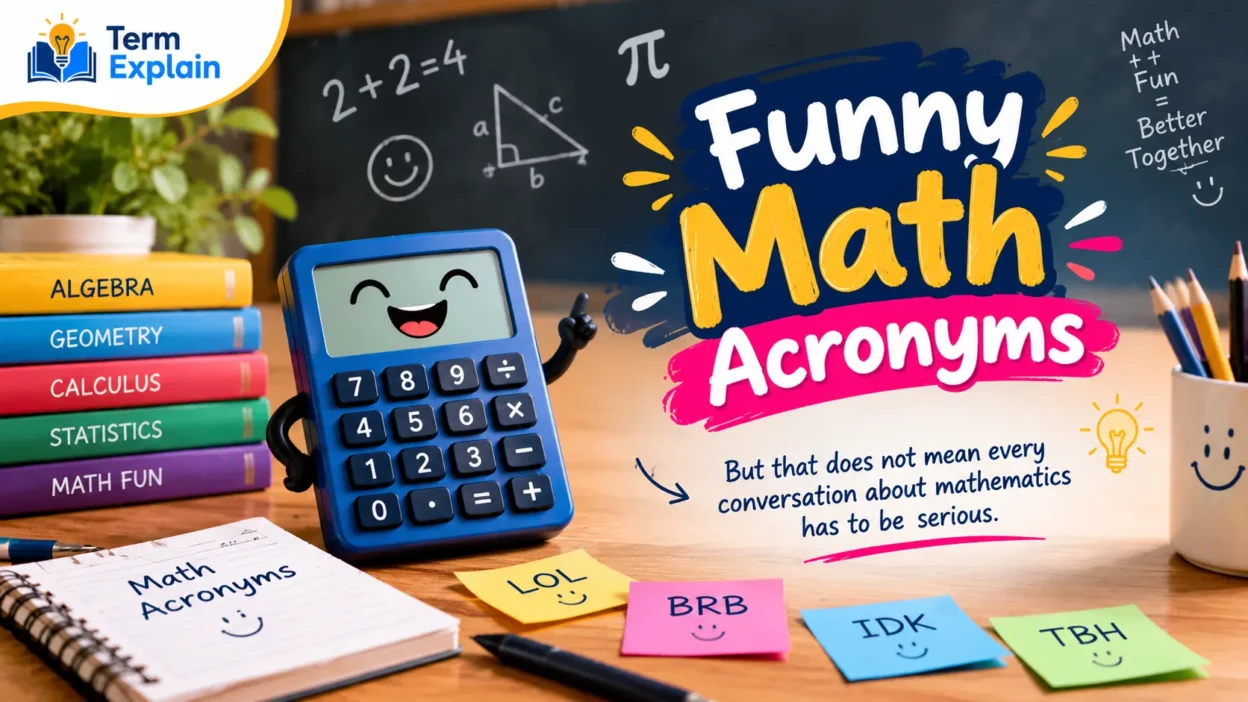
Math can be serious when you are solving equations, preparing for an exam, or trying to understand a difficult formula.
But that does not mean every conversation about mathematics has to be serious. Funny math acronyms add humor to a subject that can sometimes feel confusing, giving students, teachers, and math lovers a playful way to talk about numbers, calculations, and homework.
An acronym is a shortened form created from the initial letters of a group of words and usually pronounced as a word. In everyday conversation, people also use the term more loosely for humorous initial-letter combinations.
Abbreviations are a broader category that includes many other shortened forms, while initialisms are typically spoken letter by letter.
Funny math acronyms are especially useful in classroom jokes, study-group chats, school presentations, social media captions, and conversations about challenging assignments.
Some play on familiar mathematical terms, while others are creative phrases designed purely for entertainment.
In this guide, you will find 21 funny math acronyms and playful initial-letter expressions, along with their intended meanings, examples, and suitable contexts.
You will also learn how to distinguish established mathematical abbreviations from invented jokes, avoid confusing terminology, and use mathematical humor naturally without sacrificing clarity.
Quick Reference Table
| Acronym or Expression | Full Form | Meaning | Tone | Common Usage Context |
|---|---|---|---|---|
| PEMDAS | Parentheses, Exponents, Multiplication and Division, Addition and Subtraction | A standard order of operations that can inspire homework jokes | Educational | Classrooms, homework |
| BODMAS | Brackets, Orders, Division and Multiplication, Addition and Subtraction | An order-of-operations convention used in many educational settings | Educational | Mathematics lessons |
| LOL | Laughing Out Loud | A reaction to a funny math problem or joke | Casual | Texting, social media |
| OMG | Oh My God | Expresses surprise at a difficult equation | Casual | Student chats |
| SOS | Save Our Souls | A humorous way to ask for help with a difficult problem | Playful | Study groups |
| ASAP | As Soon As Possible | Adds urgency to a homework request | Casual | Class messages |
| IDK | I Don’t Know | Expresses confusion about a calculation | Casual | Texting |
| BRB | Be Right Back | Signals a short break from studying | Casual | Online study sessions |
| TTYL | Talk To You Later | Ends a study conversation | Casual | Messaging |
| DIY | Do It Yourself | Describes trying to solve a problem independently | Casual | Homework |
| FAQ | Frequently Asked Questions | A collection of common questions about a math topic | Informational | Study guides |
| GPA | Grade Point Average | A measure of academic performance in many education systems | Informational | School, college |
| IQ | Intelligence Quotient | A score associated with certain standardized intelligence tests | Informational | General discussion |
| π (Pi) | Pi, approximately 3.14159 | A mathematical constant that can inspire wordplay | Educational | Geometry jokes |
| X | Unknown variable, depending on the equation | The mystery number in many algebra problems | Playful | Algebra |
| + | Plus sign | Represents addition and can symbolize positivity | Playful | Math jokes |
| − | Minus sign | Represents subtraction and can inspire jokes about losing points | Playful | Homework humor |
| √ | Square root symbol | Represents a square root operation | Educational | Algebra |
| ∞ | Infinity symbol | Represents infinity, a concept without a finite bound | Playful | Math captions |
| π Day | Pi Day | A celebration of the mathematical constant pi on March 14 | Playful | School activities |
| Mathlete | Math + athlete | A playful term for someone who participates in mathematics competitions or enjoys math challenges | Playful | School culture |
A quick accuracy note: Not every item in this table is technically an acronym. Some are standard abbreviations, mathematical symbols, concepts, or playful word combinations. The list includes these related expressions because they are useful for understanding and creating funny math-themed language.
21 Funny Math Acronyms and Expressions
The examples below combine established mathematical terminology with familiar abbreviations and clearly identified wordplay. Creative jokes are presented as playful interpretations, not as official mathematical definitions.
1. PEMDAS — Parentheses, Exponents, Multiplication and Division, Addition and Subtraction
PEMDAS is a widely taught mnemonic for remembering the order of operations. It helps students determine which operations to perform first when an expression contains several mathematical symbols.
The humor comes from how stressful the expression can look when every operation seems to demand attention at once. Students might jokingly describe PEMDAS as the rule that decides the fate of their homework.
Where it’s commonly used: Mathematics classrooms, worksheets, tutoring, and study groups.
Tone: Educational, with room for playful humor.
Example: “PEMDAS is the only reason my calculator and I are still on speaking terms.”
Similar terms: BODMAS, BIDMAS.
2. BODMAS — Brackets, Orders, Division and Multiplication, Addition and Subtraction
BODMAS serves a similar purpose to PEMDAS. It reminds students to follow an agreed order when evaluating mathematical expressions. The word orders commonly refers to powers and roots in this context.
A funny way to use it is to imagine BODMAS as a strict classroom supervisor that refuses to let anyone skip the rules.
Where it’s commonly used: School mathematics, particularly in regions where BODMAS is the familiar convention.
Tone: Educational and playful.
Example: “BODMAS is the boss of my calculations, and apparently, I am not management.”
Similar terms: PEMDAS, BIDMAS.
3. LOL — Laughing Out Loud
LOL is a common texting initialism used to signal amusement. It is not specifically mathematical, but it fits naturally into conversations about funny mistakes, surprising answers, and confusing equations.
Imagine a friend confidently calculating that two plus two equals five. LOL can communicate that you find the mistake funny without turning the conversation into a serious correction.
Where it’s commonly used: Text messages, group chats, online classes, and social media.
Tone: Casual and humorous.
Example: “You used a calculator to work out 10 minus 3 and got 12? LOL.”
Similar terms: LMAO, ROFL.
4. OMG — Oh My God
OMG expresses surprise, shock, or disbelief. In a math-related conversation, it works particularly well when an assignment contains far more questions than expected.
It does not have a mathematical definition; its connection to math comes from the situation in which it is used.
Where it’s commonly used: Student messages, informal conversations, and social media captions.
Tone: Casual and expressive.
Example: “OMG, the teacher assigned 40 algebra questions for tomorrow!”
Similar terms: LOL, IDK.
5. SOS — Save Our Souls
SOS is a recognized distress signal. In informal student conversations, people sometimes use it jokingly to suggest that they desperately need assistance with a difficult subject.
A student who cannot solve a geometry problem might send an SOS message to a classmate. The joke works because the student presents ordinary homework frustration as an emergency.
Where it’s commonly used: Study-group chats, tutoring conversations, and informal classroom messages.
Tone: Playful, occasionally dramatic.
Example: “SOS! Can someone explain how to solve this quadratic equation?”
Similar terms: ASAP, IDK.
6. ASAP — As Soon As Possible
ASAP communicates urgency. Although it is used in workplaces and everyday communication, students can use it when asking for notes, solutions, or an explanation before a deadline.
For humor, the acronym can make a small homework request sound like an urgent mission.
Where it’s commonly used: School messages, emails, group chats, and workplace communication.
Tone: Casual or professional, depending on context.
Example: “Please send me the geometry notes ASAP; my test is tomorrow.”
Similar terms: SOS, FYI.
7. IDK — I Don’t Know
IDK is a familiar initialism for expressing uncertainty. It can be especially relatable when a student understands the question but cannot work out which formula to use.
Unlike a mathematical symbol, IDK describes the person’s reaction rather than the calculation itself.
Where it’s commonly used: Texting, online discussions, and student group chats.
Tone: Casual, sometimes self-deprecating.
Example: “IDK why my answer keeps coming out negative.”
Similar terms: IMO, TBH.
8. BRB — Be Right Back
BRB lets someone know they will briefly leave a conversation. During an online study session, a student might use it before getting water, taking a short break, or looking for a notebook.
Its humorous side appears when the break is caused by a particularly frustrating equation.
Where it’s commonly used: Messaging apps, online classes, and virtual study groups.
Tone: Casual and friendly.
Example: “BRB, I need a snack before I attempt question number 15.”
Similar terms: TTYL, AFK.
9. TTYL — Talk To You Later
TTYL is a casual way to end a conversation while suggesting that communication may continue later. It is useful when a student has finished studying for the moment or needs to leave a group chat.
For a math joke, it can imply that the student needs a temporary escape from equations.
Where it’s commonly used: Texting, social media, and informal study conversations.
Tone: Friendly and casual.
Example: “I have stared at these fractions long enough. TTYL!”
Similar terms: BRB, GTG.
10. DIY — Do It Yourself
DIY refers to doing a task independently instead of relying on someone else to complete it. In a math setting, it can describe attempting a problem alone before asking a teacher or classmate for help.
A student might jokingly call a complicated calculation a DIY project when no one is available to explain it.
Where it’s commonly used: Homework discussions, educational content, and informal conversations.
Tone: Practical and playful.
Example: “I tried a DIY approach to this algebra problem, but the answer still makes no sense.”
Similar terms: FAQ, IDK.
11. FAQ — Frequently Asked Questions
FAQ labels a collection of questions that people commonly ask about a subject. A math teacher might prepare an FAQ covering fractions, percentages, equations, or common examination mistakes.
The humor comes from repeatedly asking the same question even after the answer has been explained.
Where it’s commonly used: Educational websites, classroom resources, and study guides.
Tone: Informational, sometimes humorous.
Example: “My math FAQ has one main question: Why does the answer change when I check it?”
Similar terms: Q&A, DIY.
12. GPA — Grade Point Average
GPA is a measure of academic performance used by many educational institutions, although grading scales and calculations vary. It is not a funny expression by itself, but it can feature in jokes about examinations and demanding mathematics courses.
The key is to joke about academic pressure without suggesting that a student’s grades determine their intelligence or worth.
Where it’s commonly used: Schools, colleges, universities, and academic discussions.
Tone: Informational or playful.
Example: “I hope my GPA appreciates all the time we are spending together, especially during math week.”
Similar terms: IQ, grade average.
13. IQ — Intelligence Quotient
IQ refers to a score derived from certain standardized intelligence tests. It is not a measure of every ability, and it should not be treated as a complete description of someone’s intelligence.
For math humor, IQ works best when the joke targets a moment of confusion rather than insulting someone’s abilities.
Where it’s commonly used: General discussions, educational contexts, and casual jokes.
Tone: Informational or playful.
Example: “My IQ feels perfectly fine until the algebra worksheet appears.”
Similar terms: GPA, problem-solving ability.
14. π (Pi) — The Mathematical Constant
Pi is the mathematical constant representing the ratio of a circle’s circumference to its diameter. Its decimal expansion begins 3.14159 and continues without terminating or repeating.
Pi is a natural source of mathematical wordplay because its name sounds like the word pie. That connection makes it useful for classroom decorations, jokes, and Pi Day activities.
Where it’s commonly used: Geometry lessons, math clubs, school celebrations, and science humor.
Tone: Educational and playful.
Example: “I came for the pi lesson and stayed because someone brought actual pie.”
Similar terms: π Day, circumference, diameter.
15. X — The Unknown Variable
In algebra, (x) is commonly used as a variable whose value may be unknown. It is not an acronym, but it is a familiar symbol that lends itself to funny math expressions.
The classic joke is that students spend so much time trying to find (x) that they start wondering why it disappeared in the first place.
Where it’s commonly used: Algebra classes, homework, and math-themed captions.
Tone: Playful.
Example: “I have been searching for X all afternoon. Has anyone checked the lost-and-found?”
Similar terms: Variables, equations, unknowns.
16. + — The Plus Sign
The plus sign represents addition. Outside mathematics, the word plus can also suggest an advantage or a positive feature, making it useful for simple wordplay.
A math joke might describe a good study partner as the plus sign in an otherwise difficult day.
Where it’s commonly used: Arithmetic lessons, captions, classroom posters, and informal jokes.
Tone: Positive and playful.
Example: “Having a friend who explains fractions is a definite plus.”
Similar terms: Minus sign, addition, positive numbers.
17. − — The Minus Sign
The minus sign represents subtraction or, in suitable mathematical contexts, a negative value. Because the word minus can also suggest a shortage or disadvantage, it creates an easy opportunity for humor.
Students might joke about losing points after making a small calculation error.
Where it’s commonly used: Arithmetic, algebra, homework conversations, and math memes.
Tone: Playful.
Example: “The minus sign took away my points and my confidence in one move.”
Similar terms: Plus sign, subtraction, negative numbers.
18. √ — The Square Root Symbol
The square root symbol indicates a square root operation. For example, the principal square root of 25 is 5 because (5 \times 5 = 25).
The symbol can inspire jokes about students looking for the root of a problem while struggling to remember the correct operation.
Where it’s commonly used: Algebra, geometry, mathematics worksheets, and classroom jokes.
Tone: Educational and playful.
Example: “I found the square root of 25, but I still cannot find the root of my homework stress.”
Similar terms: Exponents, powers, radicals.
19. ∞ — The Infinity Symbol
The infinity symbol represents infinity, a mathematical concept associated with something without a finite bound. Its exact interpretation depends on the mathematical context.
In everyday humor, it is often used figuratively to exaggerate how long something seems to take.
Where it’s commonly used: Math captions, student conversations, and informal social media posts.
Tone: Playful and exaggerated.
Example: “The number of practice questions my teacher assigned feels like infinity.”
Similar terms: Infinite series, limits, unbounded quantities.
20. Pi Day — A Celebration of Mathematics
Pi Day is observed on March 14 because the date can be written as 3/14 in the month/day format, matching the opening digits of pi: 3.14.
Although Pi Day is not an acronym, it is closely connected to mathematical humor. Schools often use the occasion for pi-themed activities, puzzles, and wordplay involving circular shapes and pie.
Where it’s commonly used: Schools, mathematics clubs, educational events, and social media.
Tone: Educational and celebratory.
Example: “Our Pi Day plan is simple: solve a geometry puzzle and enjoy a slice of pie.”
Similar terms: Pi, geometry, circumference.
21. Mathlete — Math + Athlete
Mathlete is a playful blend of math and athlete. It describes someone who participates in mathematics competitions or enjoys challenging mathematical problems.
Unlike a traditional acronym, it is a portmanteau: a word formed by blending parts of other words. It is a friendly way to celebrate mathematical skill without making the subject sound intimidating.
Where it’s commonly used: School math clubs, competitions, classroom activities, and student conversations.
Tone: Encouraging and playful.
Example: “The mathletes are ready for the quiz, armed with pencils, formulas, and snacks.”
Similar terms: Math team member, problem solver, math competitor.
Acronyms vs. Abbreviations vs. Initialisms
These terms are related, but they do not mean exactly the same thing. Understanding the difference helps you recognize which expressions are established language shortcuts and which are mathematical symbols or jokes.
| Type | What It Means | Example |
|---|---|---|
| Abbreviation | A broad term for a shortened form of a word or phrase | Dr. for Doctor |
| Acronym | A shortened form created from initial letters and generally pronounced as a word | NASA |
| Initialism | A shortened form whose letters are pronounced individually | LOL, GPA |
| Mathematical symbol | A written sign representing an operation, quantity, or concept | +, −, √ |
| Portmanteau | A word formed by blending parts of other words | Mathlete |
The boundaries are not always strict in everyday conversation. People often call initialisms such as LOL acronyms, even though the letters are normally spoken individually. In technical writing, however, distinguishing the categories can improve precision.
PEMDAS and BODMAS are educational mnemonics, while X and π are mathematical notation rather than acronyms. Mathlete is a blended word, and Pi Day is the name of a celebration. These distinctions matter when you are writing an educational article or explaining terminology to students.
Common Mistakes When Using Math Acronyms
Treating every shortened expression as an acronym
A mathematical symbol, initialism, abbreviation, and acronym are not interchangeable technical terms. Identify the correct category when accuracy matters.
Using informal expressions in formal assignments
LOL and OMG may be suitable for a friendly class chat, but they generally do not belong in a formal mathematical proof or academic report. Use clear, conventional language when explaining your reasoning.
Assuming everyone understands the same term
Students may know PEMDAS, while others learn BODMAS or BIDMAS. If your audience comes from different educational backgrounds, explain the order-of-operations convention you are using.
Misreading the tone
A message such as “SOS, I cannot solve this equation” is often a humorous request for help, not a literal emergency. Still, consider the surrounding conversation before assuming that every dramatic message is a joke.
Confusing similar mathematical rules
PEMDAS and BODMAS are different mnemonic arrangements for the same general order-of-operations principle. Multiplication and division have equal precedence, as do addition and subtraction, so operations at the same level are generally evaluated from left to right. The letters should not be interpreted as requiring multiplication before division in every expression.
Inventing a full form and presenting it as official
You can create a humorous phrase from the letters of a familiar term, but label it as a joke or personal interpretation. Do not present a made-up expansion as an established mathematical definition.
Ignoring the audience or setting
A joke that works in a student group chat might distract from an explanation in a textbook. Consider the reader’s age, familiarity with the subject, language background, and expectations before choosing an expression.
How to Use Acronyms in Different Settings
In professional emails
Prefer clear language and familiar abbreviations. ASAP can be appropriate when urgency matters, but explain less familiar terms when writing to someone outside your team.
Instead of writing, “SOS, this calculation is impossible,” try, “Could you help me check this calculation before the deadline?”
In academic writing
Use recognized mathematical notation and follow the terminology established in your course or discipline. Introduce an unfamiliar abbreviation after its full form when you expect to use it repeatedly.
For example, write “grade point average (GPA)” on first use if your audience might not know the abbreviation. Avoid inserting unrelated texting expressions into formal explanations.
In texting and study groups
Informal expressions such as LOL, IDK, BRB, and TTYL can make conversations quicker and friendlier. A little mathematical wordplay can also make a stressful revision session feel more relaxed.
However, if someone is asking for help with a real problem, make sure the joke does not replace the explanation they need.
In international communication
Do not assume that every student has learned the same mnemonic. Educational conventions and preferred abbreviations vary between countries and institutions.
For instance, explain whether you are using PEMDAS or BODMAS when teaching order of operations to an international audience. A short clarification can prevent mistakes caused by unfamiliar terminology.
When introducing an acronym
If an expression is unfamiliar or important to your explanation, give its full form first and introduce the shortened version in parentheses. After that, use the shorter form consistently.
A simple rule is to prioritize understanding over brevity. Acronyms save space only when the reader already understands them or can easily learn what they mean.
Practice: Test Your Knowledge of Funny Math Acronyms
Use these exercises to review the expressions and mathematical terms covered in this article. The questions focus on recognizing meanings and choosing the right expression for each situation.
Fill in the Blanks
Complete each sentence with the correct acronym or term.
- The mnemonic used to remember the order of operations in many US classrooms is ______.
- In BODMAS, the letter B stands for ______.
- The texting expression ______ means “Laughing Out Loud.”
- If you do not know how to solve an equation, you might text your friend “______” to ask for help.
- The abbreviation ______ means “As Soon As Possible.”
- When you need to leave a conversation briefly, you can write ______.
- The mathematical constant representing the ratio of a circle’s circumference to its diameter is called ______.
- The symbol ______ commonly represents an unknown variable in algebra.
- The symbol ______ represents the square root operation.
- Someone who enjoys mathematics competitions might playfully be called a ______.
Multiple-Choice Questions
Choose the best answer for each question.
- What is the main purpose of PEMDAS?A. To measure academic performanceB. To remember the order of mathematical operationsC. To calculate a student’s GPAD. To represent infinity
- Which expression means “I Don’t Know”?A. IDKB. ASAPC. BRBD. TTYL
- Which of these is a mathematical symbol rather than an acronym?A. OMGB. FAQC. √D. GPA
- Why is March 14 associated with Pi Day?A. It represents the first two digits of infinity.B. The date can be written as 3/14, matching the opening digits of pi.C. It is the date when all circles were discovered.D. It represents the square root of 14.
- What is the best approach when using an unfamiliar acronym in a formal report?A. Assume every reader understands it.B. Replace all technical terms with jokes.C. Introduce the full form and explain the shortened version.D. Use as many acronyms as possible.
Rewrite the Full Sentence Using an Acronym
Rewrite each sentence using the appropriate expression from the article.
- “I will talk to you later after I finish these algebra questions.”
- “Please send me the class notes as soon as possible.”
- “I don’t know why my calculation is incorrect.”
- “I will be right back after getting my notebook.”
- “Laughing out loud, that math joke was unexpectedly funny.”
Answer Key
Fill in the blanks
- PEMDAS
- Brackets
- LOL
- SOS
- ASAP
- BRB
- Pi (π)
- X
- √
- Mathlete
Multiple-choice answers
- B — Remembering the order of mathematical operations.
- A — IDK.
- C — The square root symbol.
- B — The date corresponds to 3.14 in month/day format.
- C — Introduce the full form and explain the shortened version.
Sentence rewrites
- “TTYL after I finish these algebra questions.”
- “Please send me the class notes ASAP.”
- “IDK why my calculation is incorrect.”
- “BRB after getting my notebook.”
- “LOL, that math joke was unexpectedly funny.”
Frequently Asked Questions
What are some funny math acronyms?
PEMDAS and BODMAS are genuine mathematical mnemonics that can inspire classroom humor. LOL, OMG, and IDK also work well in math-related conversations, while X, pi, and the infinity symbol provide material for mathematical wordplay.
What does PEMDAS mean in math?
PEMDAS stands for Parentheses, Exponents, Multiplication and Division, Addition and Subtraction. It helps students remember the order of operations. Multiplication and division share the same precedence, as do addition and subtraction.
Are funny math acronyms suitable for students?
Yes. Age-appropriate mathematical jokes can make lessons, revision sessions, and study-group conversations more enjoyable. Humor works best when it supports learning rather than distracting students from understanding the concepts.
What is the difference between a math acronym and a math joke?
A mathematical acronym or mnemonic uses letters to represent a phrase or help someone remember a rule. A math joke uses mathematical ideas, symbols, or situations to create humor. Some expressions can serve both purposes, but many mathematical jokes are not acronyms.
Can I create my own funny math acronyms?
Yes. You can invent humorous letter combinations for classroom posters, group chats, or study activities. Make sure the intended meaning is clear, the wording fits the letters, and any invented expansion is identified as a joke rather than an official mathematical term.
Conclusion
Funny math acronyms and expressions offer a simple way to bring humor into homework, classroom discussions, and everyday conversations about numbers.
From PEMDAS and BODMAS to LOL, IDK, and playful references to pi and infinity, each expression can serve a different purpose.
The most important thing is to understand what an expression actually means, recognize whether it is an established term or a creative joke, and use it with the right audience.
A little humor can make mathematics more approachable, but clear explanations remain essential when accuracy matters.

Alden Rowen is a contributing author at Word Explain, specializing in abbreviations and acronyms. He creates clear, concise, and easy-to-understand explanations to help readers discover the meanings of commonly used terms and keywords.