

Elon Musk is associated with electric vehicles, space exploration, artificial intelligence, social media, and ambitious technology projects.
Discussions about his companies and ideas often include shortened terms that can be confusing for readers who are unfamiliar with engineering, business, or technology.
Acronyms and other abbreviations make communication faster by replacing long technical or organizational names with shorter forms.
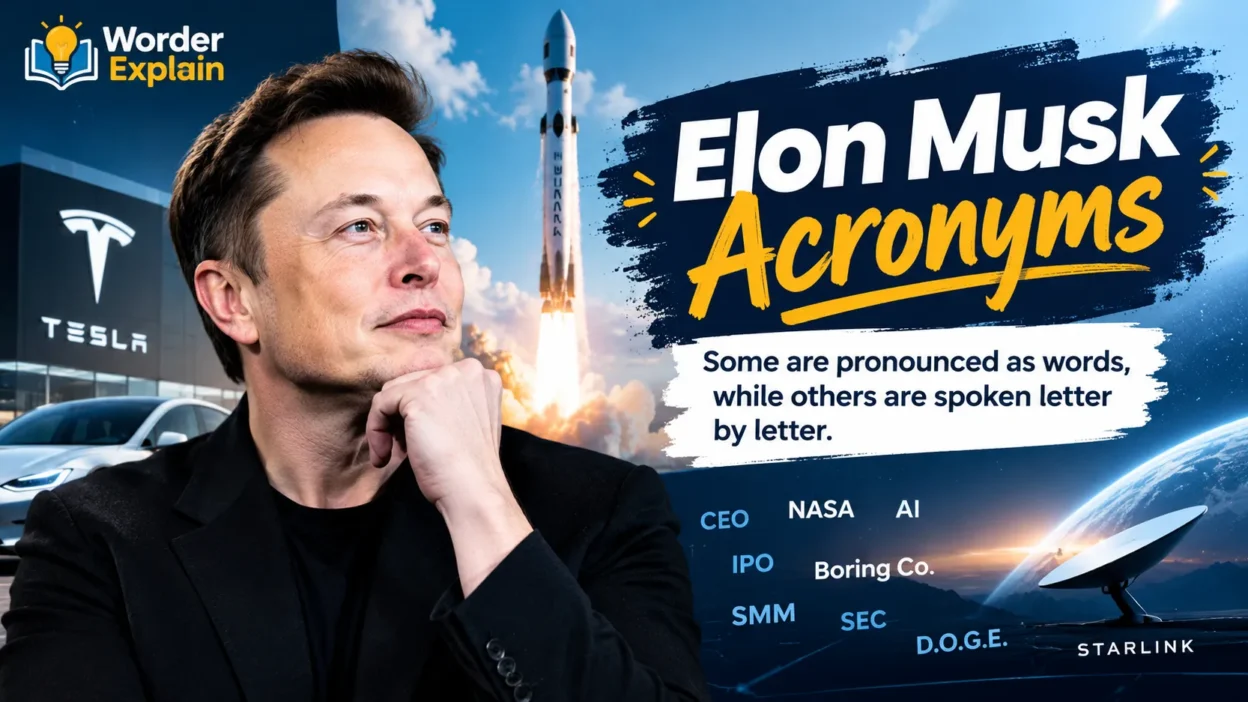
Some are pronounced as words, while others are spoken letter by letter. For example, AI refers to artificial intelligence, EV means electric vehicle, and FSD is short for Full Self-Driving.
These terms frequently appear in conversations about Tesla, SpaceX, xAI, Neuralink, and related industries.
However, not every abbreviation associated with Elon Musk was created by him or his companies. Many are established industry terms used across the technology and business worlds.
Understanding that distinction helps readers interpret news reports, product announcements, online discussions, and technical explanations accurately.
In this guide, you will learn 21 acronyms and initialisms relevant to Elon Musk’s business and technology interests. Each entry explains the full form, practical meaning, common context, tone, and a realistic example. You will also find a quick-reference table, common usage mistakes, writing guidance, practice exercises, and answers to frequently asked questions.
Quick Reference Table
| Acronym | Full Form | Meaning | Tone | Common Usage Context |
|---|---|---|---|---|
| AI | Artificial Intelligence | Machines performing tasks associated with human intelligence | Professional | xAI, Tesla |
| AGI | Artificial General Intelligence | AI capable of a broad range of intellectual tasks | Technical | AI research |
| LLM | Large Language Model | AI model trained to process and generate language | Technical | xAI, chatbots |
| FSD | Full Self-Driving | Tesla’s driver-assistance feature name | Technical | Tesla vehicles |
| ADAS | Advanced Driver Assistance Systems | Technologies that assist drivers | Professional | Automotive engineering |
| EV | Electric Vehicle | A vehicle powered by electricity | General | Tesla, transportation |
| OTA | Over-the-Air | Wireless delivery of software updates | Technical | Tesla software |
| BMS | Battery Management System | Electronics that monitor and protect a battery | Technical | Electric vehicles |
| HVAC | Heating, Ventilation, and Air Conditioning | Systems that control indoor temperature and air | Technical | Vehicles, buildings |
| R&D | Research and Development | Work to create or improve products and technology | Professional | Tesla, SpaceX |
| CEO | Chief Executive Officer | The senior executive responsible for leading a company | Professional | Business news |
| CTO | Chief Technology Officer | Executive responsible for technology strategy | Professional | Technology companies |
| IPO | Initial Public Offering | A company’s first public sale of shares | Financial | Company markets |
| SEC | Securities and Exchange Commission | U.S. federal securities regulator | Formal | Financial regulation |
| NASA | National Aeronautics and Space Administration | U.S. civilian space agency | Formal | Space exploration |
| FAA | Federal Aviation Administration | U.S. aviation regulator | Formal | SpaceX launches |
| FCC | Federal Communications Commission | U.S. communications regulator | Formal | Satellite communications |
| ISS | International Space Station | A research laboratory orbiting Earth | Scientific | Space missions |
| E2E | End-to-End | A process or system considered from beginning to end | Technical | AI, software |
| DOGE | Department of Government Efficiency | Name used for a U.S. government initiative in 2025 | Political | Government policy |
| NHTSA | National Highway Traffic Safety Administration | U.S. road-vehicle safety regulator | Formal | Vehicle safety |
These terms do not all have the same linguistic status. Some are conventional acronyms, some are initialisms, and some use numbers or other nonstandard letter combinations. They are grouped here because they help readers understand discussions surrounding Elon Musk’s work and associated industries.
21 Elon Musk Acronyms and Their Meanings
1. AI — Artificial Intelligence
AI describes computer systems designed to perform tasks that normally require human-like abilities, such as recognizing patterns, generating text, analyzing information, or making predictions.
It is especially relevant to xAI’s language models and Tesla’s work on driver assistance and other intelligent systems. AI is a broad field, not the name of one particular product or company.
Where it’s commonly used: Technology news, research, Tesla, xAI, robotics, and online discussions.
Tone: Professional and general.
Example: “I’m following xAI because I want to understand how AI systems are improving.”
Similar acronyms: AGI, LLM.
2. AGI — Artificial General Intelligence
AGI describes a proposed form of artificial intelligence that can handle a wide range of intellectual tasks rather than being limited to a narrow set of functions. Researchers do not agree on one universally accepted threshold for achieving it.
The term frequently appears in conversations about advanced AI development and long-term technology goals. It should not be treated as synonymous with today’s chatbots or as proof that a particular system has reached human-level general intelligence.
Where it’s commonly used: AI research, technology interviews, and discussions about future computing.
Tone: Technical and forward-looking.
Example: “The panel discussed what capabilities would be needed to build AGI.”
Similar acronyms: AI, LLM.
3. LLM — Large Language Model
An LLM is an AI model trained on large amounts of language data to recognize patterns and generate or interpret text. Depending on its design, it may also support tasks such as summarization, coding, and question answering.
LLMs are important when discussing conversational AI products, including systems developed by xAI. The term describes a type of model rather than a guarantee that its responses are correct.
Where it’s commonly used: AI development, software engineering, research, and chatbot discussions.
Tone: Technical.
Example: “The developer tested the LLM on coding and reasoning tasks.”
Similar acronyms: AI, AGI.
4. FSD — Full Self-Driving
FSD is Tesla’s name for a driver-assistance feature package. Its capabilities can include steering, navigating turns, and performing other driving maneuvers, depending on the version and market.
The name must not be interpreted as a guarantee of fully autonomous driving. Tesla’s current FSD (Supervised) system requires an attentive driver who remains responsible for the vehicle. <Cite refs={[“turn977063search0″,”turn977063search1”]}/>
Where it’s commonly used: Tesla vehicle discussions, automotive technology, and driver-assistance news.
Tone: Technical and product-specific.
Example: “Before using FSD, the driver checked the instructions and understood the supervision requirements.”
Similar acronyms: ADAS, EV.
5. ADAS — Advanced Driver Assistance Systems
ADAS refers to technologies that help drivers perform driving tasks or improve vehicle safety. Examples include automatic emergency braking, lane assistance, and adaptive cruise control.
This term provides useful context for understanding Tesla’s driver-assistance features. ADAS is an industry-wide category, not a Tesla-exclusive technology.
Where it’s commonly used: Automotive engineering, vehicle manuals, safety reports, and car reviews.
Tone: Professional and technical.
Example: “The reviewer compared the ADAS features available in several electric vehicles.”
Similar acronyms: FSD, EV.
6. EV — Electric Vehicle
An EV is a vehicle powered wholly or partly by electricity, although the term is often used specifically for fully electric cars in everyday conversation. A battery-electric vehicle does not rely on a conventional gasoline engine for propulsion.
EV is particularly relevant to Tesla because the company develops and sells electric vehicles. The term also applies to products from many other manufacturers.
Where it’s commonly used: Automotive news, transportation policy, charging discussions, and consumer reviews.
Tone: General and professional.
Example: “My next car might be an EV because I can charge it at home.”
Similar acronyms: FSD, BMS.
7. OTA — Over-the-Air
OTA describes the wireless delivery of software, firmware, or other updates to a connected device. In the automotive industry, this can allow supported vehicle software to be updated without a traditional workshop-based installation.
Tesla is well known for distributing software updates to compatible vehicles. However, an OTA update does not necessarily add every advertised feature to every vehicle; hardware, region, and software compatibility can matter.
Where it’s commonly used: Vehicle software, smartphones, connected devices, and technology support.
Tone: Technical.
Example: “The vehicle received an OTA update that changed some software features.”
Similar acronyms: EV, FSD.
8. BMS — Battery Management System
A BMS monitors and manages a rechargeable battery. Depending on the design, it can track voltage, temperature, and charge levels while helping protect the battery from unsafe operating conditions.
Battery management is important in electric vehicles and energy storage systems. It helps manufacturers balance performance, reliability, and battery longevity.
Where it’s commonly used: Electric vehicles, battery engineering, energy storage, and electronics.
Tone: Technical.
Example: “The engineer checked the BMS data to investigate the battery warning.”
Similar acronyms: EV, HVAC.
9. HVAC — Heating, Ventilation, and Air Conditioning
HVAC refers to the systems that regulate heating, cooling, airflow, and indoor air conditions. In vehicles, these systems help maintain a comfortable cabin temperature and manage airflow.
In discussions about Tesla and other electric cars, HVAC matters because climate control can affect passenger comfort and energy consumption.
Where it’s commonly used: Automotive design, buildings, engineering, and maintenance.
Tone: Technical and professional.
Example: “The technician inspected the HVAC system after the cabin stopped cooling properly.”
Similar acronyms: BMS, EV.
10. R&D — Research and Development
R&D covers activities undertaken to discover new technologies, develop products, test ideas, and improve existing systems. It can include laboratory research, engineering prototypes, experiments, and product development.
For companies associated with Elon Musk, R&D is relevant to electric vehicles, rocket technology, robotics, batteries, and AI. It is a general business term rather than a Musk-specific expression.
Where it’s commonly used: Corporate reports, engineering, innovation, and business planning.
Tone: Professional.
Example: “The company increased its R&D efforts to improve battery performance.”
Similar acronyms: AI, IPO.
11. CEO — Chief Executive Officer
The CEO is generally the highest-ranking executive responsible for leading a company’s overall direction and major business decisions. The exact responsibilities depend on the company’s governance structure.
The title frequently appears in reporting about Elon Musk’s executive roles and the companies associated with him. It describes a position, not a particular management style.
Where it’s commonly used: Business news, company announcements, interviews, and professional communication.
Tone: Professional.
Example: “The CEO presented the company’s long-term strategy to investors.”
Similar acronyms: CTO, IPO.
12. CTO — Chief Technology Officer
A CTO is an executive who typically leads an organization’s technology strategy, technical direction, or innovation priorities. The precise role varies by organization.
The title is useful when reading about technology leadership at companies working on AI, vehicles, aerospace, and software. A CTO’s responsibilities are not automatically identical to those of a CEO.
Where it’s commonly used: Technology companies, executive profiles, corporate reports, and recruitment.
Tone: Professional.
Example: “The CTO explained how the engineering team planned to improve the software.”
Similar acronyms: CEO, R&D.
13. IPO — Initial Public Offering
An IPO occurs when a company offers its shares to public investors for the first time. The process can involve financial disclosures, regulatory requirements, and underwriting arrangements.
The term often appears in discussions about company valuations, investment opportunities, and whether a private business might enter public markets. Mentioning an IPO does not mean a company has announced or scheduled one.
Where it’s commonly used: Financial news, investment discussions, and business analysis.
Tone: Formal and financial.
Example: “Investors wanted to know whether the company had plans for an IPO.”
Similar acronyms: CEO, SEC.
14. SEC — Securities and Exchange Commission
The SEC is the U.S. federal agency responsible for administering and enforcing important federal securities laws and overseeing major parts of the securities markets.
It is relevant to some Elon Musk-related business and financial news because public-company disclosures, securities regulation, and investor communications can fall within the agency’s remit. The SEC is a regulator, not a stock exchange.
Where it’s commonly used: Financial reporting, legal discussions, corporate disclosures, and investment news.
Tone: Formal.
Example: “The journalist reviewed the company’s filing with the SEC.”
Similar acronyms: IPO, CEO.
15. NASA — National Aeronautics and Space Administration
NASA is the U.S. government agency responsible for the country’s civilian space program and a broad range of aeronautics and space-science activities.
NASA is relevant to SpaceX because the two organizations have worked together on space transportation and crewed missions. The agency and the private company are separate organizations with different responsibilities.
Where it’s commonly used: Space exploration, science reporting, astronaut missions, and aerospace education.
Tone: Formal and scientific.
Example: “NASA worked with SpaceX on a mission to transport astronauts to orbit.”
Similar acronyms: FAA, ISS.
16. FAA — Federal Aviation Administration
The FAA is the U.S. federal agency responsible for civil aviation safety and related regulatory functions. Its responsibilities include overseeing aspects of commercial space launch and reentry licensing under applicable rules.
The FAA matters in discussions of SpaceX launches because commercial spaceflight operates within a regulatory framework. A launch schedule or authorization can depend on regulatory and operational conditions.
Where it’s commonly used: Aerospace reporting, aviation safety, launch coverage, and regulatory news.
Tone: Formal and technical.
Example: “The reporter checked the FAA’s announcement before describing the planned launch.”
Similar acronyms: NASA, FCC.
17. FCC — Federal Communications Commission
The FCC regulates interstate and international communications by radio, television, wire, satellite, and cable in the United States, within its statutory authority.
It is relevant to satellite internet services, including Starlink, because satellite communications involve spectrum and other regulatory considerations. The FCC should not be confused with the FAA, which has different responsibilities.
Where it’s commonly used: Telecommunications, satellite internet, broadcasting, and regulatory reporting.
Tone: Formal.
Example: “The company submitted information to the FCC about its satellite communications plans.”
Similar acronyms: FAA, NASA.
18. ISS — International Space Station
The ISS is a research facility in low Earth orbit where participating space agencies and crews conduct scientific experiments and technology demonstrations.
It is relevant to SpaceX because the company has supported cargo and crew transportation to the station. The ISS is an international project, not a SpaceX-owned spacecraft.
Where it’s commonly used: Space science, astronaut missions, aerospace education, and research news.
Tone: Scientific and formal.
Example: “The crew prepared for its journey to the ISS.”
Similar acronyms: NASA, FAA.
19. E2E — End-to-End
E2E describes a process or system considered across its complete path, from an initial input or starting point to the final result. In software and AI, the exact meaning depends on the technical context.
For example, an end-to-end AI approach may learn a mapping from inputs to outputs rather than relying on a collection of separately designed stages. In other settings, E2E can refer to testing an entire workflow.
Where it’s commonly used: AI engineering, software development, testing, and systems design.
Tone: Technical.
Example: “The engineers ran E2E tests to check whether the entire workflow functioned correctly.”
Similar acronyms: AI, LLM.
20. DOGE — Department of Government Efficiency
DOGE was the name used for a U.S. government initiative associated with efforts to reduce federal spending and change government operations in 2025. Elon Musk became closely associated with the initiative during that period.
The term has a political and administrative context, unlike automotive or aerospace abbreviations. It should also not be confused with Dogecoin, the cryptocurrency that is commonly represented by the ticker DOGE.
Where it’s commonly used: U.S. politics, government spending debates, news coverage, and online discussions.
Tone: Political; potentially controversial depending on the discussion.
Example: “The article examined DOGE’s proposed approach to federal spending.”
Similar terms: SEC, CEO. Dogecoin’s DOGE ticker is a related spelling but has a different meaning.
21. NHTSA — National Highway Traffic Safety Administration
NHTSA is the U.S. federal agency responsible for important aspects of motor vehicle safety, including vehicle safety standards, defect investigations, and oversight of vehicle recalls.
The agency is relevant to Tesla-related reporting when a matter involves vehicle safety, driver-assistance systems, or potential defects. An investigation or information request should not automatically be interpreted as proof that a company has violated the law.
Where it’s commonly used: Vehicle safety reports, recalls, automotive journalism, and regulatory announcements.
Tone: Formal and technical.
Example: “The news report said NHTSA was reviewing a vehicle safety concern.”
Similar acronyms: ADAS, FSD, SEC.
Acronyms vs. Abbreviations vs. Initialisms
These terms are related, but they do not mean exactly the same thing.
| Term | What It Means | Example |
|---|---|---|
| Abbreviation | Any shortened form of a word or phrase | R&D |
| Acronym | A shortened form made from initial letters and generally pronounced as a word | NASA |
| Initialism | A shortened form whose letters are spoken individually | CEO |
An abbreviation is the broad category. Acronyms and initialisms are two ways of forming shortened expressions from longer names or phrases.
For example, NASA is usually pronounced as a word, whereas CEO is generally spoken as three separate letters. Both communicate a longer expression in a compact form.
Some terms, including AI and EV, are commonly called acronyms in everyday conversation even though they are more precisely classified as initialisms. Usage is not always strict, so context matters more than terminology alone.
Numbers and mixed characters can appear in technical shorthand, too. E2E is commonly read as “end-to-end,” while DOGE is pronounced as a word. Not every shortened expression follows exactly the same formation rule.
Common Mistakes When Using Elon Musk Acronyms
1. Assuming every acronym belongs to Elon Musk
AI, NASA, CEO, and EV are widely used terms. Their appearance in an article about Musk does not mean he invented them.
2. Treating FSD as proof of full autonomy
Tesla’s FSD (Supervised) requires driver supervision. Readers should distinguish the product’s name from its actual operating requirements.
3. Mixing up similar organizations
The FAA deals with aviation and aspects of commercial spaceflight regulation, while the FCC handles communications regulation. NASA has a different mission again.
4. Confusing DOGE with Dogecoin
The same letters can refer to the government initiative or the cryptocurrency ticker. Read the surrounding sentence to identify the intended meaning.
5. Using unexplained technical shorthand
A reader may recognize EV but not BMS or E2E. Introducing unfamiliar terms in full before using their shortened forms makes technical writing easier to follow.
6. Overusing abbreviations in formal writing
Too many shortened forms can make an article difficult to read. Use them when they improve clarity or avoid unnecessary repetition, not merely to make sentences look technical.
7. Misreading tone
CEO and R&D are ordinary business terms. DOGE can appear in politically charged discussions, while AGI often signals a technical or speculative debate. The meaning may be stable even when the tone of the conversation changes.
How to Use Acronyms Correctly
In professional emails
Write the full form when a recipient may not recognize the abbreviation. After introducing it, use the shortened form consistently.
Example: “The research and development (R&D) team will present its findings on Friday.”
For familiar terms such as CEO, introducing the full form may be unnecessary if the audience already understands it.
In academic writing
Follow the style guide or publication requirements. Introduce a technical abbreviation at first use when appropriate, and define it even if you expect some readers to know it.
Example: “Advanced driver assistance systems (ADAS) can support specific driving tasks.”
Avoid informal internet shorthand in research papers unless the subject itself requires it.
In texting and online discussions
Short forms can make messages more concise, especially when discussing familiar topics.
Example: “The EV review mentioned an OTA update.”
However, concise writing should still be understandable. A string of unexplained technical terms can make even a short message confusing.
In international communication
Spell out uncommon terms because readers may work in different industries, speak different first languages, or follow different regional conventions.
For example, an article about SpaceX might introduce the Federal Aviation Administration (FAA) before using the abbreviation throughout the rest of the text.
When to introduce the full form
A practical rule is to write the complete name first, followed by the abbreviation in parentheses, when the term may be unfamiliar or appears repeatedly.
For a short article, there may be no need to introduce an abbreviation that appears only once. For a technical report, defining it at first use is often helpful.
Above all, match the terminology to the audience. A battery engineer may know BMS immediately, while a general reader may need a brief explanation.
Practice Exercises
Use the terms explained above to check your understanding.
Fill in the blanks
- ______ refers to artificial intelligence.
- A ______ is trained to process and generate language.
- Tesla uses the product name ______ for its Full Self-Driving feature.
- A vehicle powered by electricity is commonly called an ______.
- Wireless software delivery is described as ______.
- A ______ monitors and manages a rechargeable battery.
- The executive title meaning Chief Executive Officer is ______.
- A company’s first public share offering is an ______.
- The U.S. civilian space agency is ______.
- The U.S. agency associated with motor vehicle safety is ______.
Multiple-choice questions
- Which term refers to Advanced Driver Assistance Systems?A. ADAS
B. AGI
C. IPO
D. ISS - What does LLM describe?A. A battery protection device
B. A large language model
C. A public share offering
D. A satellite regulator - Which agency regulates U.S. communications within its statutory authority?A. NASA
B. NHTSA
C. FCC
D. FAA - What does R&D mean?A. Research and Development
B. Road and Driving
C. Radio and Data
D. Research and Distribution - In the political context described above, what does DOGE refer to?A. A Tesla vehicle model
B. A government efficiency initiative
C. A battery system
D. A space station
Rewrite each sentence using the acronym
Replace the bold full form with the appropriate acronym.
- The Chief Executive Officer discussed the company’s strategy.
- The team is investing in Research and Development.
- The vehicle received an Over-the-Air software update.
- The engineers evaluated the Advanced Driver Assistance Systems.
- The astronauts prepared to travel to the International Space Station.
Answer key
Fill in the blanks
- AI
- LLM
- FSD
- EV
- OTA
- BMS
- CEO
- IPO
- NASA
- NHTSA
Multiple choice
- A — ADAS
- B — A large language model
- C — FCC
- A — Research and Development
- B — A government efficiency initiative
Rewrite the sentences
- The CEO discussed the company’s strategy.
- The team is investing in R&D.
- The vehicle received an OTA software update.
- The engineers evaluated the ADAS.
- The astronauts prepared to travel to the ISS.
Frequently Asked Questions
What are the most common acronyms associated with Elon Musk?
AI, EV, FSD, R&D, CEO, and NASA are useful starting points for understanding discussions about his business and technology interests. Other terms become important when reading about satellite communications, vehicle safety, or AI research.
Did Elon Musk invent these acronyms?
No. Most terms in this guide are established industry, scientific, business, or government abbreviations. They are relevant because they appear in discussions about industries and organizations associated with Musk, not because he personally coined them.
What does FSD mean in Tesla discussions?
FSD means Full Self-Driving, Tesla’s name for a driver-assistance feature package. FSD (Supervised) requires an attentive driver and does not make a vehicle fully autonomous.
What is the difference between AI, AGI, and LLM?
AI is the broad field of artificial intelligence. AGI describes a proposed form of AI capable of handling a broad range of intellectual tasks. An LLM is a language-focused AI model trained to process and generate text. These terms describe different concepts and are not interchangeable.
Why does DOGE have two different meanings?
DOGE can refer to the Department of Government Efficiency in a U.S. political context or to Dogecoin’s cryptocurrency ticker. The surrounding discussion determines which meaning is intended.
Conclusion
Understanding Elon Musk-related acronyms makes it easier to follow conversations about electric vehicles, artificial intelligence, space exploration, company leadership, and government regulation.
The most useful approach is to learn both the full form and the context in which each term appears.
Remember that not every abbreviation is a technically defined acronym, and not every term associated with Musk originated with him.
Introduce unfamiliar expressions clearly, distinguish similar terms, and choose language that suits your audience.
With these habits, technical articles, business news, and online discussions become easier to understand.

Alden Rowen is a contributing author at Word Explain, specializing in abbreviations and acronyms. He creates clear, concise, and easy-to-understand explanations to help readers discover the meanings of commonly used terms and keywords.